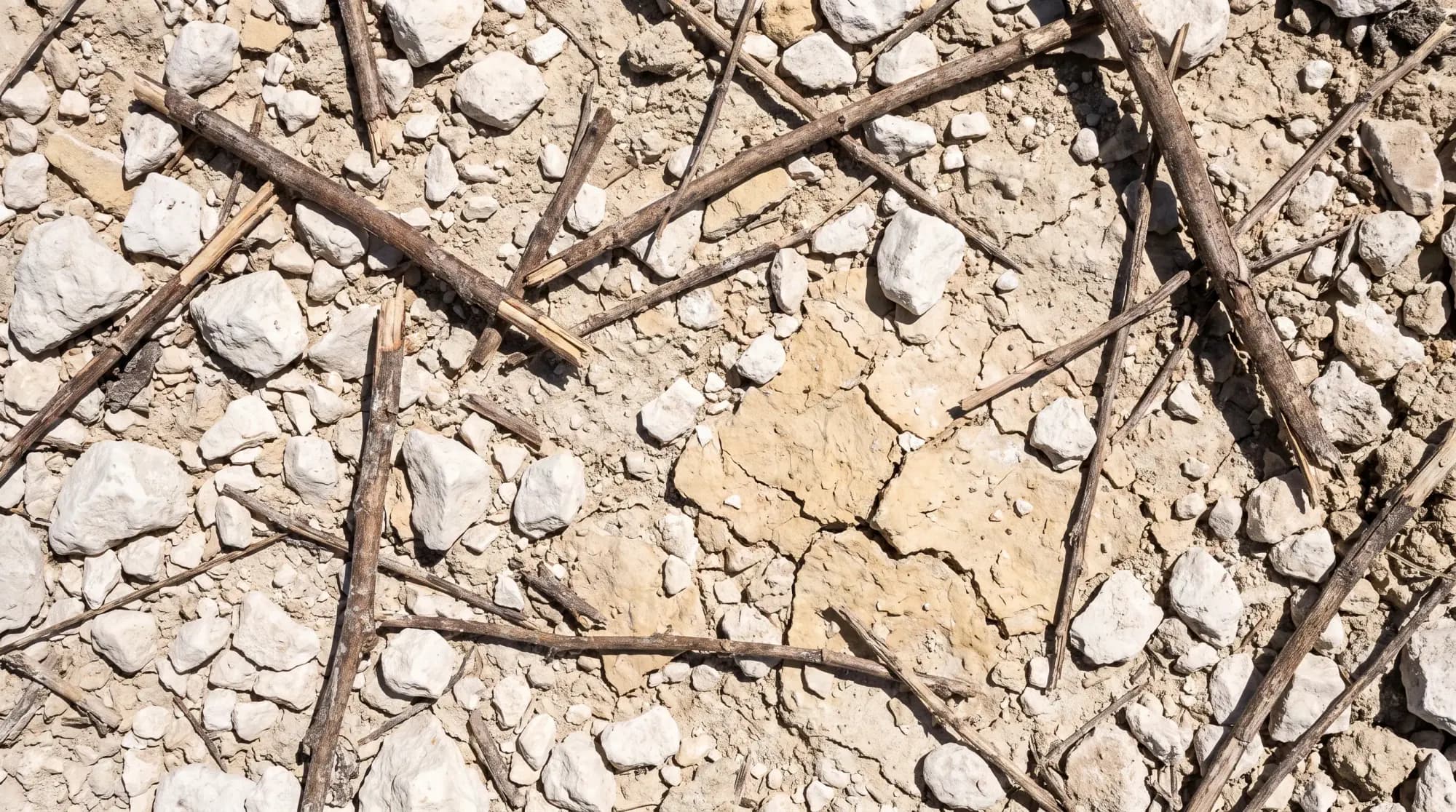
The terroir of the Cahors AOC rests on a geological system that is singular in France: a limestone plateau — the causses (limestone plateaus) of the Quercy — overlooks a deeply incised river whose meanders have, over hundreds of thousands of years, deposited alluvial terraces that grow older as they climb. Between the two, clay-limestone hillsides close the triptych. These three zones produce three different styles of Cahors, and it is this diversity that today makes the appellation rich — and arguably legitimises the project to classify Premier Cru sites in the Lot.
This page revisits the geology, the climate and the concrete impact of each zone on the wine's profile. For an overview, see our complete guide to the Cahors AOC.
A geology sculpted by the Lot
The Cadurcian vineyard stretches east to west along the Lot, a river whose deep meanders (the famous "loops" of Cahors, Luzech, Albas and Puy-l'Évêque) have carved into the Quercy limestone plateau. This fluvial erosion, spread over several million years, has shaped the three major terroir units:
- The causse — a limestone plateau (200–350 m elevation) overlooking the valley.
- The alluvial terraces — successive levels laid down by the Lot (100–200 m), forming platforms of gravel and clay.
- The hillsides and intermediate slopes — clay-limestone gradients between causses and valley.
To this vertical structure is added the right bank / left bank split: the right bank faces due south, warmer and earlier; the left bank, more tempered, often produces fresher, more tensile wines.
The Quercy causses
Geology
The causses are limestone plateaus belonging to the Kimmeridgian formation (Upper Jurassic) and the Bathonian limestone (Middle Jurassic), dating from around 150 million years ago. The soil here is thin, stony, sometimes almost absent: the bedrock often surfaces. Drainage is excellent but water retention is limited.
We speak of karst: a landscape marked by sinkholes, swallow holes and the chasms characteristic of limestone plateaus eroded by groundwater. Vines on the causse grow in this mineral environment, sometimes with barely 30 cm of loose earth above the limestone slab.
Local climate
The causses rise 200–350 metres above the valley. This gives them:
- cooler nights than in the valley (up to 8–10 °C difference in summer),
- more direct sun exposure, with no shading,
- increased ventilation, which keeps the vines healthy,
- a slightly later harvest than in the valley.
This day/night thermal gap is crucial for preserving the acidity and aromatic freshness of Malbec. For climatic detail, see our climate and soils of the Cahors AOC.
Style of causse wines
Cahors wines from the causse share several traits:
- maximum concentration (naturally low yields, often 35–40 hl/ha),
- firm, upright tannins that need time to polish,
- acid freshness preserved by altitude,
- aromatic profile marked by black fruits, spices, garrigue and — with age — leather and truffle,
- maximum cellaring potential: 15 to 25 years for the longer-ageing cuvées.
It is on the causse that several reference estates are found, including Clos de Pougette at Cournou, Château de Chambert at Floressas and Mas del Périé at Trespoux-Rassiels.
The Lot Valley and its terraces
Over the Quaternary period (the last 2.5 million years), the river deposited a succession of alluvial levels known as terraces. Each terrace corresponds to a specific period in the river's history. At Cahors, three levels are traditionally distinguished.
The first terrace (T1)
The most recent, sitting just above the current Lot riverbed at 90–120 metres elevation. The soils are modern alluvium: silts, sands, recent gravels, with good fertility and natural freshness (proximity of the water table).
Style: fruity Cahors, accessible young, to drink within 5–8 years. Good freshness but less dense structure than on higher terroirs.
The second terrace (T2)
At 130–160 metres, the second terrace blends gravels, sands and clay, sometimes with outcrops of alios (a distinctive cemented sandstone). It is the most heavily represented zone numerically: most of the great "estate" cuvées are born here.
Style: balanced Cahors, present tannic structure without rusticity, fine cellaring potential (8–15 years). It is on T2 that Clos Triguedina produces some of its most acclaimed cuvées.
The third terrace (T3)
At 160–200 metres, the third terrace is made up of the oldest alluvium. Soils are stony, free-draining and poor. This is the alluvial level that yields the valley's most powerful wines — often halfway between the lower terraces and the causses.
Style: concentration, complexity, strong ageing potential (12–20 years). Several historic grands crus are on T3.
Summary table
| Zone | Elevation | Soils | Typical profile | Cellaring |
|---|---|---|---|---|
| First terrace (T1) | 90–120 m | Silts, sands, recent gravels | Fruity, fresh, accessible young | 5–8 years |
| Second terrace (T2) | 130–160 m | Mixed gravel/clay, alios | Balanced, structured, expressive | 8–15 years |
| Third terrace (T3) | 160–200 m | Rolled pebbles, free-draining, poor | Concentrated, complex, long-finishing | 12–20 years |
| Intermediate slopes | 150–250 m | Deep clay-limestone | Balanced, terroir-driven | 10–15 years |
| Causses | 200–350 m | Bedrock limestone, thin soil | Concentrated, firm, fresh, very long | 15–25 years |
The clay-limestone hillsides
Between the terraces and the causses, the intermediate slopes form a transition zone often overlooked in general descriptions. They are deep clay-limestone soils, more structured than the terraces, deeper than the causses. Many of the appellation's historic estates are on these slopes, which yield balanced, expressive Cahors wines.
Exposure plays an enormous role here: a south-facing slope at Caillac (Château Lagrézette) does not behave like a north-facing slope at Albas. The microclimates are numerous, and the best winemakers exploit this diversity plot by plot.
Water and root depth
A point often overlooked: water availability varies radically between the three zones. On the lower terraces, the water table is close (3–5 metres), and Malbec draws on it without difficulty. On the causses, water is scarce, and roots plunge deep — sometimes 15–20 metres through fissures in the limestone — to reach residual moisture.
This root depth is a signature of causse Cahors wines. It partly explains their ability to resist drought (an increasingly strategic asset against climate change) and their pronounced minerality — the roots carry the bedrock's signature back into the wine.
How this terroir expresses itself in the glass
A few concrete examples of terroir expression, worth exploring in a comparative tasting:
- A first-terrace Cahors offers, on the palate, a crisp fruit (blackcurrant, black cherry) and a fresh, accessible finish.
- A second-terrace Cahors combines fruit and structure: present tannic grip without harshness, medium to good length.
- A causse Cahors stands out for its mineral density and freshness despite the concentration — this paradox is the mark of great Cahors. Tannins are firm but silky on a finished wine.
- An intermediate-slope Cahors is often the most immediately appealing: ripe fruit, round tannins, clean finish.
When visiting estates that offer several "plot-specific" cuvées (for example Clos de Pougette, Château de Chambert or Cosse-Maisonneuve), ask to compare a causse cuvée with a terrace cuvée — the exercise is illuminating.
The Cahors Crus classification project
Since 2016, the UIVC and the INAO have been working on an official classification of the Cahors appellation along Burgundian-Bordelais lines. The initial project aimed at two complementary new designations distinguishing Cahors of terraces / plateau / causse from Cahors of valley / hillsides, with implementation targeted for the 2020 vintage — a timetable that proved optimistic. The file remains under discussion at the INAO, supported by academic terroir-mapping work (published on the Territoires du vin platform).
The project advances step by step — an appellation like Cahors does not classify itself overnight. But the momentum is launched, and several winemakers are already working their plots with this horizon in mind. For range benchmarks, see our buying guide.
Sources: Wikipedia — Geology of Quercy · BRGM — French Geological Survey · Pierre Casamayor, Le terroir cadurcien · Decanter — Cahors terroir. Page updated 14 May 2026.
Alcohol abuse is dangerous for your health. Please drink responsibly.