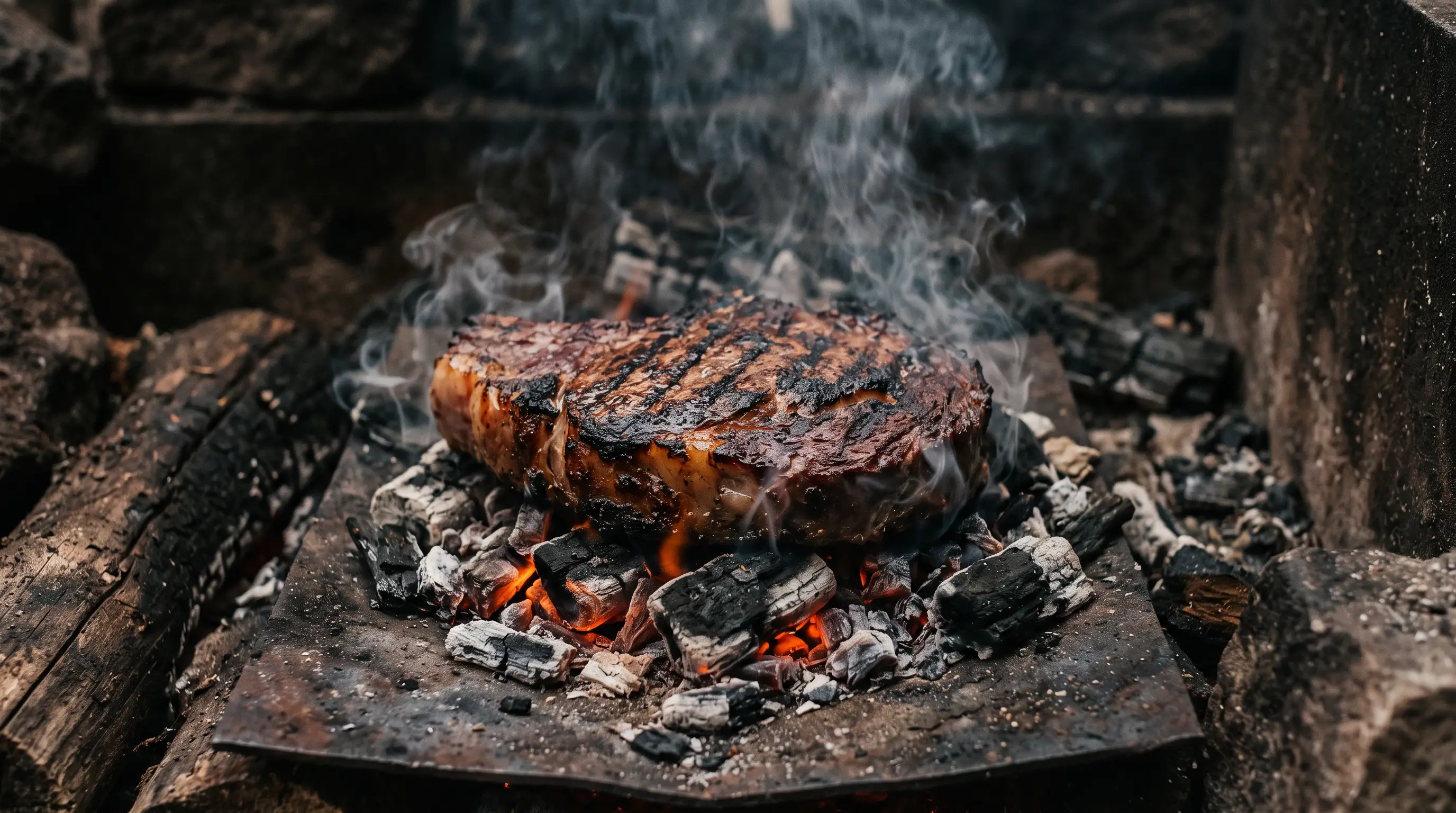
Cahors is one of the great red wines of South-West French cooking — and well beyond it. Its tannic structure, acid freshness and aromatic range make it a remarkably versatile companion at table, provided you match the wine to both the dish and the vintage. This guide covers the classic pairings, the contemporary ones, serving temperatures and the traps to avoid.
For general background, see our complete guide to the Cahors AOC.
The three rules that govern everything
Before the detail, three structural rules underpin every Cahors pairing.
Rule 1 — Tannin cuts fat
The firm tannins of Malbec excel at cutting through rich, fatty dishes: confit, duck breast, aged cheeses, braised meat. That is their primary strength at table.
In practice :
- With a classic duck confit, the tannin scrubs the palate between mouthfuls and stops the sense of saturation building.
- With a pink roast leg of lamb, Cahors tannin balances the fat of the meat without fighting the rare cooking.
- With a thick-cut dry-aged rib of beef, the tannin gives the dish a frame without masking the char.
Conversely, with a lean pork tenderloin or a plain veal escalope, Cahors tannin has nothing to cut — the pairing tips out of balance and the wine reads as aggressive.
Rule 2 — Acidity keeps the palate alive
Cahors's acid freshness restarts salivation between mouthfuls, which prevents the cloying sensation dense dishes create (cassoulet, gratin, slow-cooked stews).
In practice :
- With a Toulouse cassoulet that has been in the oven for three hours, salivation tires by the third mouthful. The acidity of Cahors Malbec restarts it — one reason this regional pairing works so well.
- With a potato gratin dauphinois alongside red meat, Cahors's acidity avoids the "full mouth" effect a wine without acid tension produces.
- With reduced cream sauces (sweetbreads, blanquette), the same rule applies: Cahors only works where the sauce is concentrated enough to need that acid tension.
Rule 3 — Age reveals the terroir
With subtle dishes — feathered game, truffle, very slow-matured cheeses — reach for a mature Cahors (10 years or more) rather than a young one. Tertiary complexity partners these dishes far better than dominant primary fruit.
In practice :
- Roast pigeon with figs on a young Cahors: the primary fruit (blackcurrant, blackberry) competes with the sweet sauce and the fine flesh of the bird. On a 12-to-15-year-old Cahors, the tertiary notes — leather, undergrowth, cocoa — converse with the dish instead of covering it.
- Scrambled eggs with black truffle on a 10-year-plus Prestige cuvée: the earthy notes of the tuber meet the evolution of the Malbec in something close to fusion.
- Old mountain Cantal (24-36 months) on a mature Cahors: the tertiary complexity of both answers each other, where a young Cahors would flatten the cheese.
Pairings by Cahors style
Another useful angle: start from the wine rather than the dish. Three broad profiles call for three different families of food.
Young and fruity Cahors (1-5 years) — accessible but structured
Profile : deep purple, fresh black fruit (blackcurrant, blackberry, plum), tannic structure present without excess, short to medium finish. Mostly estate Tradition cuvées and the lower terraces.
What works :
- South-West charcuterie (dry sausage, Bayonne ham, chorizo).
- Grilled rib of beef, plain, with no elaborate sauce.
- Duck breast, simply grilled with salt and pepper.
- Roast leg of lamb with a few herbs (thyme, rosemary).
- Young sheep's milk cheeses (mild Ossau-Iraty, Quercy sheep's tomme).
What to avoid on this profile : dishes with complex sauces, which flatten the primary fruit, and heavily spiced dishes, where the youthful acidity runs away.
Ripe and structured Cahors (6-12 years) — the appellation's core register
Profile : deep ruby, cooked black fruit plus spice and emerging cocoa, resolved but silky tannins, long finish. Prestige cuvées and Grands Crus du Lot in their main drinking window.
What works :
- Cassoulet in all its variants — Castelnaudary, Toulouse, Carcassonne (see our cassoulet feature).
- Duck confit with sarladaises potatoes.
- Duck breast with black pepper or red fruit.
- Beef bourguignon and similar slow-cooked dishes.
- Wild boar civet, at the opening of the hunting season.
- Ceps in risotto, sautéed with parsley and garlic, or as a velouté.
- Mature Cantal aged 12-18 months, and Roquefort for those who like a bold match.
This is the appellation's central register — the one that earns it a place in serious French gastronomy.
Mature and complex Cahors (12-25 years and beyond) — the great gastronomic pairings
Profile : garnet turning tawny at the rim, tertiary aromatics (undergrowth, leather, light tobacco, truffle, prune), tannins melted to velvet, a very long and complex finish. Icon cuvées at full maturity and Grands Crus du Lot from the great vintages (2015, 2016, 2020).
What works :
- Roast pigeon with figs, grapes or ceps — one of the great matches.
- Lièvre à la royale — the classic autumn showpiece.
- Roast woodcock or wood pigeon — the most accomplished feathered-game pairing.
- Black truffle from the Quercy on scrambled eggs, risotto or plain toast.
- 36-month Comté or old mountain tomme.
- Beef Wellington in its pastry with mushroom duxelles.
This is the register of special occasions — celebration meals, tasting dinners, the last bottles in a cellar.
The essential regional pairings
Cassoulet and Cahors
The greatest regional pairing in the South-West. See our dedicated feature on cassoulet and Cahors for the family recipe and the three variants (Castelnaudary, Toulouse, Carcassonne).
Suggested profile : 8-12 years, Tradition or Prestige depending on the cassoulet. Cosse-Maisonneuve "Le Combal", Gaudou "Renaissance".
Duck confit
As fundamental as cassoulet. The controlled bitterness of the tannin balances the confit fat. Suggested profile : 5-10 years, estate or Prestige cuvée.
Duck breast
Here the pairing turns on the sauce and the cooking. Plainly grilled: a young, fruity Cahors of 5-8 years. With black pepper or red fruit: a mature Cahors.
Garbure
A dense country soup of cabbage, tarbais beans, confit and country ham. Garbure is the rustic ancestor of cassoulet — same structure, simpler. A Tradition Cahors of 4-6 years, served slightly cool at 15-16 °C (59-61 °F), works beautifully. No need to open a grand cru for a farmhouse dish.
Game (venison, wild boar, hare)
A major autumn pairing. Cahors's spice profile and mineral base answer the wild notes of game. Go for a cellared Cahors of 8-15 years with genuine aromatic complexity.
Stuffed Agen prunes and cooked fruit
A regional speciality that echoes the prune notes characteristic of mature Malbec. An intuitive and delicious match on a 10-to-12-year-old Cahors.
Foie gras: why the answer is no
A sensitive subject. Foie gras and Cahors do not work as a starter, despite their shared regional origin. We would rather say so plainly:
- Pan-fried fresh foie gras as a starter : the creamy fat flattens Cahors's tannic structure. The palate blurs and the wine loses definition. Choose a Monbazillac, a sweet Jurançon, or a very taut dry white instead (Quincy, an older Sancerre).
- Foie gras au torchon served cold : the same problem, made worse by the cold, which hardens tannin. Choose a sweet wine (Sauternes, Monbazillac, Tokaji).
- Pan-fried foie gras with red fruit as a main course : here the pairing becomes possible on an 8-to-10-year-old Prestige cuvée, provided game or meat is served alongside. Never as a starter on its own.
This is the single most common mistake in South-West cooking. The logic of "regional plus regional equals a match" simply does not hold here. Worth knowing, and worth passing on.
Grilled and roast red meat
Rib of beef
The absolute classic. A young Cahors (5-8 years) on a plainly grilled rib; something more mature with pepper or shallot sauce.
Leg of lamb
Especially good with Quercy lamb, the regional breed. A structured, fresh Cahors — the acid freshness scrubs the richness of the lamb.
Beef bourguignon and slow-cooked dishes
Rich dishes that need a wine with real body. A Prestige Cahors of 10 years or more does the job. Avoid entry-level cuvées, which would be flattened.
Veal chops
More delicate. Reach for a light, fruity Cahors — five years, lower terraces — rather than a tannic grand cru.
Modern South-West cooking
Black truffle from the Quercy
The local pairing par excellence. On a truffle omelette, a risotto or scrambled eggs, a cellared Cahors of 10 years or more reveals the notes it shares with the tuber: undergrowth, earth, forest floor.
Ceps and wild mushrooms
Cep risotto, sautéed with parsley and garlic, or as a velouté: the earthy notes of the mushroom answer the wine's evolution. Magnificent in autumn.
Roast pigeon
One of the great pairings with mature Cahors (12-15 years). Lagrézette "Le Pigeonnier" with roast pigeon and figs — a major match, as the name suggests.
Cheese: seven alliances worth knowing
With young Cahors (3-6 years)
- Young Cantal : tender, and the Cahors adds body.
- Quercy sheep's tomme : regional, perfectly balanced.
- Farmhouse Rocamadour : a small regional goat's cheese, surprisingly good on young Cahors.
With mature Cahors (8-15 years)
- Mature Cantal : the great classic.
- Roquefort : a bold match, the sweet-salt of the blue against evolved cocoa notes. Worth trying.
- 36-month Comté : less obvious, but it works.
- Old sheep's tomme : superb with the longest Cahors on the palate.
To avoid
- Camembert, Brie : too creamy, they flatten the finesse of a mature Cahors.
- Fresh goat's cheese : too light, the tannin takes over.
- Munster, Maroilles : aromatic power that collides head-on with Cahors's tertiary notes.
Bold contemporary pairings
Asian cooking (proceed with care)
"Cahors plus Asian food" is less obvious than it sounds. Tradition by tradition:
- Cantonese — Peking duck : a mature Cahors of 10-12 years can hold both the sugar of the glaze and the fat of the duck. It is one of the rare Asian pairings where Cahors genuinely works. Choose a causse cuvée for the mineral freshness that offsets the sweetness.
- Sichuan (kung pao pork, mapo tofu) : too much Sichuan pepper; the wine's acidity runs away and the palate numbs. Avoid.
- Thai : too much fresh coriander, lemongrass, chilli and coconut milk — all of it collides with the Malbec profile. Avoid, except a mild meat curry on a very supple Cahors.
- Japanese (sushi, sashimi, tempura, ramen) : not the pairing. Cahors utterly flattens the delicacy of the preparation. Choose sake, a dry German Riesling or a brut Champagne.
- Indian — rogan josh, lamb madras : an 8-to-10-year-old Prestige cuvée can hold up if the curry is lamb-led with garam masala. Avoid anything as hot as a vindaloo.
Lamb tagine with prunes
Moroccan spices — cumin, cinnamon, ginger — sit surprisingly well with the cocoa and spice notes of a mature Malbec. One of our most successful "contemporary" pairings.
Dark chocolate, 70 % and above
A bold but successful match on a ripe Cahors of 10 years or more. Dark chocolate at 70 % minimum shares several notes with mature Malbec: cocoa, cooked black fruit, roasted character. Serve the wine cool, 15-16 °C (59-61 °F), rather than at room temperature, to protect the acid freshness.
Avoid : milk chocolate, where the sugar dominates and flattens the wine, and white chocolate, which shares nothing aromatically with Malbec.
Worth trying : a 75 % chocolate fondant served warm and slightly molten, with a Prestige Cahors of 10-12 years at 16 °C (61 °F). One of the most memorable dessert pairings we have tasted.
Gourmet burger
On a quality beef burger with aged cheese and caramelised onions, a young fruity Cahors is an excellent companion — and far more distinctive than a generic Bordeaux at the same price.
Serving and temperature
| Aspect | Recommendation |
|---|---|
| Serving temperature | 16-17 °C (61-63 °F) for young cuvées, 17-18 °C (63-64 °F) for mature ones |
| Decanting | Yes for young wines (under 5 years), optional for mature ones (over 8 years) |
| Decanting time | 30-60 minutes before serving |
| Glass | Wide tulip, Burgundy or Bordeaux shape. No specialist glass needed |
| Quantity per guest | 150-200 ml per person over a full meal |
Serving Cahors too warm — above 19 °C (66 °F) — pushes the alcohol forward and flattens the freshness. Served too cold, below 14 °C (57 °F), the tannins harden and the aromatics shut down.
Pairing mistakes to avoid
Five common errors that ruin a Cahors pairing:
- Fish in a white or herb sauce — sole meunière, grilled sea bass, cod in a herb crust. The delicacy of the fish is flattened by Malbec tannin. Choose a dry white.
- Asparagus, white or green — the asparagine reacts with tannin to produce a metallic taste. An impossible match. Choose a Loire Sauvignon.
- Very hot chilli-led dishes (chilli con carne, vindaloo, madras) — the chilli exacerbates the wine's acidity and burns the palate. Choose a full-bodied rosé, or beer.
- Foie gras as a starter — see the dedicated section above. The most frequent mistake in South-West cooking.
- Sushi, sashimi, Japanese food — delicacy flattened. Choose sake, Champagne or a dry Riesling.
Three more traps :
- A Cahors that is too young on a complex dish : firm tannins take over and the food disappears.
- A heavily oaked Cahors on a delicate dish (fish in sauce, slow-cooked vegetables) : aromatic conflict.
- A grand cru on a simple dish (steak and chips) : a mismatch of scale, and guaranteed disappointment. The reverse also fails — an entry-level Cahors on a full Toulouse cassoulet is simply swamped.
Quick reference table
| Dish | Recommended Cahors | Ideal age |
|---|---|---|
| Castelnaudary cassoulet | Tradition cuvée | 5-8 years |
| Toulouse cassoulet | Prestige | 8-12 years |
| Carcassonne cassoulet | Grand cru | 12-15 years |
| Duck confit | Estate or Prestige | 5-10 years |
| Plain duck breast | Young Tradition | 5-8 years |
| Duck breast, black pepper | Mature Prestige | 8-12 years |
| Leg of lamb | Estate cuvée | 8-12 years |
| Game | Prestige | 10-15 years |
| Black truffle | Grand cru | 10-15 years |
| Ceps / wild mushrooms | Estate or Prestige | 8-12 years |
| Roast pigeon | Grand cru | 12-15 years |
| Sheep's tomme | Estate cuvée | 5-10 years |
| Roquefort | Prestige | 10-15 years |
| Dark chocolate | Mature Prestige | 10 years + |
| Cantonese Peking duck | Mature Prestige | 10-12 years |
| Lamb tagine with prunes | Prestige | 8-12 years |
Our Cahors wines singled out by the guides page reproduces the published notes on several of these cuvées.
Sources : Pierre Casamayor, L'École des Vins du Sud-Ouest · L'Académie Universelle du Cassoulet · Wikipedia — Cuisine of South-West France · Decanter — pairing guides. Published 15 May 2026, updated 16 May 2026.