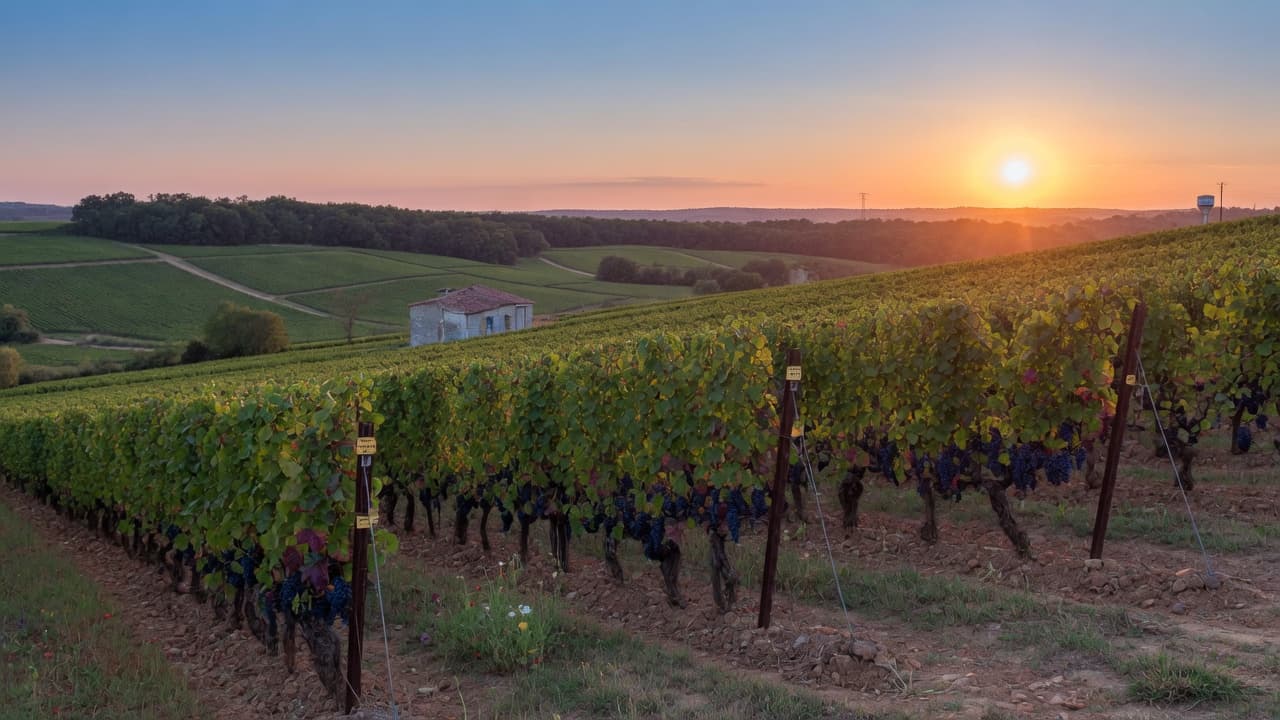
The Cahors AOC area covers 45 communes in the Lot department, stretched east to west along the river of the same name. From the prefecture of Cahors, on the left bank of the Lot, to Soturac at the edge of the Lot-et-Garonne, the vineyard extends nearly 60 km, framed by the causses (limestone plateaus) of the Quercy to the north and south. Here is the complete list and the headline villages to know if you want to grasp the appellation's geographical identity.
For a strategic reading of the terroirs crossed by these communes, see our terroir of the Cahors AOC page.
Interactive map of the 45 communes
Every commune in the appellation, coloured by geological area. The burgundy pins mark the estates we profile.
Hover a commune to see its terroir and the number of listed growers; click to open the filtered list of profiles.
Geographic data: IGN ADMIN EXPRESS (40 current communes) + OpenStreetMap (5 communes merged after 2017, polygons preserved as city districts).
The 45 communes, area by area
According to the appellation rules currently in force (INAO 2009, 2011 revision), 45 communes are authorised to produce Cahors AOC. That list has been stable since 1971. The hamlet of Cournou, where the Clos de Pougette estate is located, sits within the commune of Saint-Vincent-Rive-d'Olt — one of the 45.
Lot Valley22 communes
- Albas
- Anglars-Juillac
- Arcambal
- Cahors
- Caillac
- Castelfranc
- Douelle
- Duravel
- Grézels
- Lagardelle
- Lamagdelaine
- Luzech
- Mercuès
- Parnac
- Pescadoires
- Pradines
- Prayssac
- Puy-l'Évêque
- Saint-Vincent-Rive-d'Olt
- Soturac
- Touzac
- Vire-sur-Lot
Causse (limestone plateau)15 communes
- Bagat-en-Quercy
- Bélaye
- Cambayrac
- Carnac-Rouffiac
- Cieurac
- Fargues
- Flaujac-Poujols
- Floressas
- Lacapelle-Cabanac
- Le Boulvé
- Mauroux
- Saint-Matré
- Saux
- Trespoux-Rassiels
- Villesèque
Bouriane8 communes
- Catus
- Crayssac
- Labastide-du-Vert
- Nuzéjouls
- Pontcirq
- Saint-Médard
- Sauzet
- Sérignac
Click a commune to see the growers based there. The number shows how many profiles are available.
The headline villages
Seven communes concentrate the bulk of qualitative production and host the leading estates of the appellation.
Cahors
The prefecture of the Lot. Strictly speaking, few production vines sit within the commune boundary itself — most of the vineyard lies to the west and northwest periphery. Cahors is above all the nominal "capital" of the appellation, whose tourist profile does a great deal for the international visibility of the wine.
Luzech
Located 25 km west of Cahors, at the heart of a spectacular meander of the Lot (the Impernal peninsula). Historic vineyard, clay-limestone terroir and hillsides.
Prayssac
Market town of the middle valley, on the left bank. Around ten independent estates are established here. Weekly wine market in summer, annual wine festival. A good base for wine-tourism visits.
Puy-l'Évêque
One of the most beautiful medieval towns in the Lot, overlooking the valley. An important wine-making centre with several reference estates, including Château de Chambert (at Floressas, the neighbouring commune) and Château la Caminade at Parnac (6 km away).
Vire-sur-Lot
On the right bank, west of Puy-l'Évêque. Home of Château du Cèdre (Pascal and Jean-Marc Verhaeghe, 27 ha in organic farming since the early 1990s) and headquarters of Clos Triguedina (Sabine and Jean-Luc Baldès, 70 ha across 4 communes, seven generations since 1830). Several other leading estates are based here, including Château de Gaudou.
Albas
On the left bank, in a meander of the Lot. Hillside vineyards facing south and southeast, clay-limestone terroir. Several family estates.
Parnac and Mercuès
On the north bank of the Lot, near Cahors. Mercuès hosts a historic château converted into a hotel-restaurant and wine producer (Mercuès brand). Parnac is the headquarters of the Côtes d'Olt cooperative cellar, which gathers several dozen winemakers and produces one of the appellation's largest cuvées by volume.
Practical geography for wine tourism
Short itineraries
Three short routes let you discover the vineyard according to your angle of interest.
1. "Central Valley" itinerary (1 day) — Cahors → Mercuès → Luzech → Prayssac. To discover the hillsides and terraces of the mid-valley. Several estates welcome visitors by appointment.
2. "Floressas Causse" itinerary (1 day) — Cahors → Trespoux-Rassiels (Mas del Périé) → Floressas (Château de Chambert) → Cournou (Clos de Pougette) → return. To explore the most mineral causse terroirs. Our Cahors wine tourism guide goes deeper into each stop.
3. "Western Valley" itinerary (1–2 days) — Puy-l'Évêque → Vire-sur-Lot → Touzac → Soturac. For the western terraces and historic châteaux. You can extend into the southeast of the Lot-et-Garonne (Buzet).
Access
- By car: A20 motorway (Paris–Toulouse, exit 57 or 58 Cahors), then the D911 road that follows the Lot west. This is the main axis crossing the vineyard.
- By train: Cahors SNCF station (Paris–Toulouse line). Car hire on arrival is virtually essential for estate visits.
- By bike: the Cahors–Capdenac-Gare greenway (40 km) partly follows the Lot and links several wine-making villages. Ideal in season.
Accommodation
Several estates offer guest rooms or self-catering cottages. Cahors, Puy-l'Évêque, Prayssac and Mercuès offer the main hotel options. Our wine-tourism notebook lists partner addresses and estates welcoming visitors for a day or a stay.
Emerging communes
A few lesser-known communes are worth watching, either for their specific terroir or for the arrival of a new generation of winemakers:
- Trespoux-Rassiels: Fabien Jouves (Mas del Périé) has established a reference biodynamic estate here.
- Floressas: causse, Château de Chambert (120 ha of land and woodland including about 45 ha of vines in biodynamics, Ecocert + Demeter certified).
- Lacapelle-Cabanac: home of Cosse-Maisonneuve (Matthieu Cosse and Catherine Maisonneuve, biodynamics Demeter-certified since 1999, with a distinctive Cabernet Franc focus on the Sidérolithe and Carmenet cuvées).
- Crayssac: northwestern periphery of Cahors, confidential but quality-driven vineyards.
To follow the estates of each commune, see our directory of Cahors winemakers.
Sources: Official Cahors AOC specifications (INAO) · Wikipedia — List of Lot communes · Cahors Vallée du Lot tourism. Page updated 14 May 2026.
Alcohol abuse is dangerous for your health. Please drink responsibly.