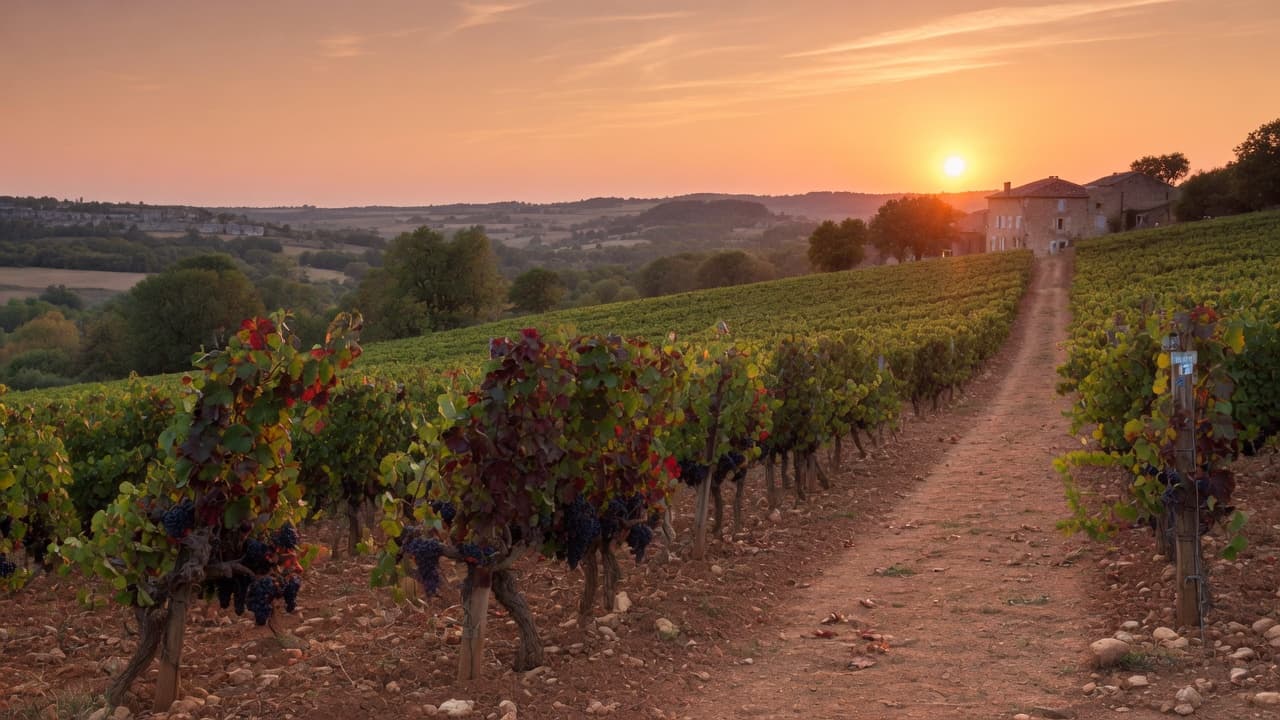
The history of Cahors wine spans nearly two thousand years, from Gallo-Roman vineyards to the qualitative revival initiated by the granting of the AOC in 1971. Between the two: a medieval golden age, a collapse caused by phylloxera and the 1956 frost, and a slow reconstruction led by a handful of stubborn winemakers. This page traces the major stages — the ones that explain why today's Cahors is what it is.
To place this story in the general context of the appellation, see our complete guide to the Cahors AOC.
The Gallo-Roman origins
The vine arrived in the Quercy with the Romans, around the first century AD, planted by colonists and legion veterans on the territory of the Cadurci (the Gallo-Roman town of Divona Cadurcorum). Locally produced amphorae have been found in archaeological digs, attesting to an early wine trade.
In AD 92, the emperor Domitian ordered the uprooting of half the vines outside Italy, to protect peninsular viticulture. Cahors was affected but resumed after the edict of Probus in AD 280, which again authorised planting. This first Cadurcian viticulture is documented by the work of regional historians and by inscriptions found in the ancient city.
The medieval golden age (12th–17th centuries)
The Aquitaine–England–Hanseatic trade triangle
The historic turning point comes in the 12th century, with the marriage of Eleanor of Aquitaine and Henry II Plantagenet in 1152. Cahors then becomes part of the "haut pays" that supplies Bordeaux, which in turn exports massively to England, Flanders and the Hanseatic League. Cahors travels by raft on the Lot down to the Garonne, then by ship to the quays of the Moon in Bordeaux.
In the inventories of England's royal cellars — where Eleanor now reigns — Cahors appears frequently. The legend that she had this wine served at her wedding is probably embellished, but the English court's attachment to the "black wine of Cahors" is well documented from the 13th century onwards.
Pope John XXII and the European diffusion
In 1316, Jacques Duèze (born in Cahors in 1244, died in Avignon in 1334), from a Cadurcian merchant family, was elected pope under the name John XXII at the age of 72. He had a new château built near Avignon, which would become Châteauneuf-du-Pape. In 1317, the first papal vine was planted there by winemakers from Cahors — the documented starting point of the Châteauneuf-du-Pape vineyard. This papal diffusion gave Cahors a European visibility unmatched at the time.
The "black wine" — an expression that appears at this period — refers to the deep colour of Malbec as compared with the lighter reds of other French vineyards. This chromatic peculiarity became a commercial asset — and would remain one until the collapse of the 19th century.
The "Bordeaux wine privilege"
From the 14th century onwards, Bordeaux progressively imposed a privilege banning the wines of the high country — and therefore Cahors — from being sold before Saint Martin's Day (11 November), to give priority to Bordeaux wines. This head-on competition lasted several centuries and limited Cahors' commercial expansion, while paradoxically preserving the Malbec culture that took lasting root in the Lot Valley.
19th century: apogee and catastrophe
Expansion before phylloxera
In the mid-19th century, the Cahors vineyard reached its historic maximum surface — sources put it between 40,000 and 58,000 hectares planted, more than ten times the current AOC area. Cahors was massively exported to Russia (tradition holds that Tsar Peter the Great discovered and appreciated it — a story relayed by local sources but with no identified contemporary archive), to Eastern Europe, to Latin America and — in part — to England.
It was during this period that the most important event for the global history of Malbec took place: on 17 April 1853, the French agronomist Michel Aimé Pouget (born 1821) was invited by the governor of Mendoza Pedro Pascual Segura to found the Quinta Normal de Mendoza, an agronomy school where he introduced French grape varieties — including Cadurcian Côt (Malbec). Planted in the Mendoza province, the vines adapted remarkably to the Andean altitude. More than a century later, Argentina would become the world's leading producer of Malbec — directly descended from Cahors. 17 April is now celebrated as Malbec World Day. Our Cahors vs Argentinian Malbec comparison revisits this legacy.
Phylloxera: 1880–1900
As across the whole French vineyard, phylloxera ravaged Cahors. The first attacks appeared in the Quercy from 1877, spreading from Bordeaux which had been hit in 1869. The blight destroyed almost the entire vineyard between 1877 and 1890 — the cadastral records of the period attest that many vines were then left fallow. Reconstruction with American rootstock was very slow: it took until 1947 for a cooperative cellar at Parnac to relaunch Côt cultivation with grafts brought in from Bordeaux growers.
The destructive frost of 1956
The death blow of the 20th century came in February 1956. An exceptional cold wave swept across the French South-West: temperatures fell to -25 °C in some areas of the Quercy. Malbec vines, poorly prepared for such a thermal shock, were wiped out across most of the vineyard.
The toll was dramatic:
- 80% of the vineyard was destroyed.
- Dozens of estates closed, unable to rebuild.
- Tannat and Merlot, more resistant, gained ground at Malbec's expense.
- Cahors, at this time, did not yet hold AOC status — it had been classified as VDQS (delimited wine of superior quality) since 1951.
This catastrophe explains why, in the 1960s, the image of Cahors was still confidential: production was low, quality uneven, and the grape that made the wine singular had almost vanished from its own lands. It was in this context that the decision to pursue AOC status was taken.
1971: the birth of the AOC
On 15 April 1971, the Cahors AOC was granted by decree. The specifications require:
- a minimum of 70% Malbec in the blend,
- production exclusively in red,
- the appellation area limited to 45 communes around the Lot,
- regulated yields and vinification techniques.
This recognition was the result of fifteen years of union work led by winemakers and cooperative members determined to rebuild Cahors' identity around its historic grape. Bringing Malbec back to the heart of the specifications was a strong political choice, going against the tide of an era dominated by Merlot.
The qualitative revival (1971–2000)
The 1970s and 1980s were marked by a rapid professionalisation of the appellation. Pioneer estates — Château Lagrézette, Clos Triguedina, Château du Cèdre — invested in modernising their cellars, Malbec clonal selection, vinification temperature control. A few key figures carried the revival:
- Jean-Luc Baldès at Clos Triguedina, who turned the "Probus" cuvée into a benchmark.
- Pascal Verhaeghe at Château du Cèdre, a precursor of the pure-Malbec approach.
- Alain-Dominique Perrin, CEO of Cartier, who bought and restored Château Lagrézette from 1980 and launched the "Le Pigeonnier" cuvée, which has established itself as one of the very greatest Cahors.
These engines pulled the entire appellation along. Production picked up, quality rose, and Cahors regained a place in the specialist guides.
21st century: biodynamics, terroir, classification
Three movements have characterised the appellation since 2000.
The rise of biodynamics
Several leading estates have moved to biodynamics or strict organic farming: Cosse-Maisonneuve (Matthieu Cosse and Catherine Maisonneuve, Demeter-biodynamic since 1999), Mas del Périé (Fabien Jouves), Château de Chambert (Philippe Lejeune, Ecocert since 2009 + Demeter), Château du Cèdre (organic AB since the early 1990s, no biodynamic certification). This shift accompanies a general trend in the French vineyard, but it has particular resonance in Cahors: the poor soils of the causses and Malbec's natural resilience lend themselves well to low-input approaches.
Terroir rediscovery
Plot-by-plot work has sharpened. Winemakers increasingly distinguish causse cuvées (concentration, freshness, long cellaring) from terrace cuvées (fruit, accessibility). The project of Premier Cru du Lot classification has been under discussion at the INAO since 2018 — it would eventually formalise a qualitative hierarchy comparable to Bordeaux or Burgundy. Our terroir of the Cahors AOC page details these three major zones.
Internationalisation
Cahors has reconnected with its historic export markets (England, Belgium) and conquered new ones: United States, Germany, Canada, China. The "cradle of Malbec" angle is increasingly emphasised to meet the curiosity of Argentinian and Anglo-Saxon wine lovers. Nearly 30% of production now leaves for export.
What next?
The Cahors of 2026 is, arguably, in the best qualitative shape of its modern history. Challenges remain numerous:
- Climate change: droughts, spring frosts (2017, 2021), heatwaves. The appellation is experimenting with resistant varieties and adapted pruning.
- Price valorisation: the quality-price ratio remains favourable to the consumer but limits growers' margins.
- Generational renewal: transmission of family estates to a new generation often more engaged with agroecology.
- Clear identification in the SERP: against the mass image of Argentinian Malbec, Cahors must work on its origin story — a task to which our publication aims to contribute.
To go deeper: see our article on the Malbec revival in Cahors since 1971, our Malbec grape page and our vintage-by-vintage analyses.
Sources: Wikipedia — History of the Cahors vineyard · Pierre Casamayor, Le Guide Hachette des Vins de Cahors · Lot Departmental Archives. Page updated 14 May 2026.
Alcohol abuse is dangerous for your health. Please drink responsibly.