The climate and soils of the Cahors AOC outline a hinge wine zone in France: halfway between the oceanic influence of Bordeaux to the west, the continental climate of the Massif Central to the north and the Mediterranean influences that rise through the Aude corridor. This singular geographical position, combined with a stable limestone bedrock inherited from the Jurassic, gives Cadurcian Malbec its freshness, its structure and its capacity to age well.
This page describes in detail the climatic and geological parameters that shape the appellation's wines. For general context, see our complete guide to the Cahors AOC and our terroir page.
A transitional climate position
The appellation sits at around 44° 30' North latitude, in a zone where three influences meet:
- oceanic from the Atlantic, bringing humidity and temperance,
- continental from the Massif Central, amplifying day/night thermal swing,
- occasional Mediterranean, rising through the South-West corridors and bringing summer heat spikes.
This climatic three-in-one is one of the keys to Cahors' identity. None of these influences dominates outright, which gives the wines a combination of solar ripeness and acid freshness rarely found elsewhere in France.
Temperatures and thermal swing
Annual averages
Based on Météo-France readings at Cahors and surrounding stations:
- Annual mean temperature: 12.5 to 13.5 °C depending on zone.
- Summer: daily averages of 22–25 °C, frequent peaks above 30 °C in July–August.
- Winter: daily averages of 5–6 °C, common morning frosts from November to March.
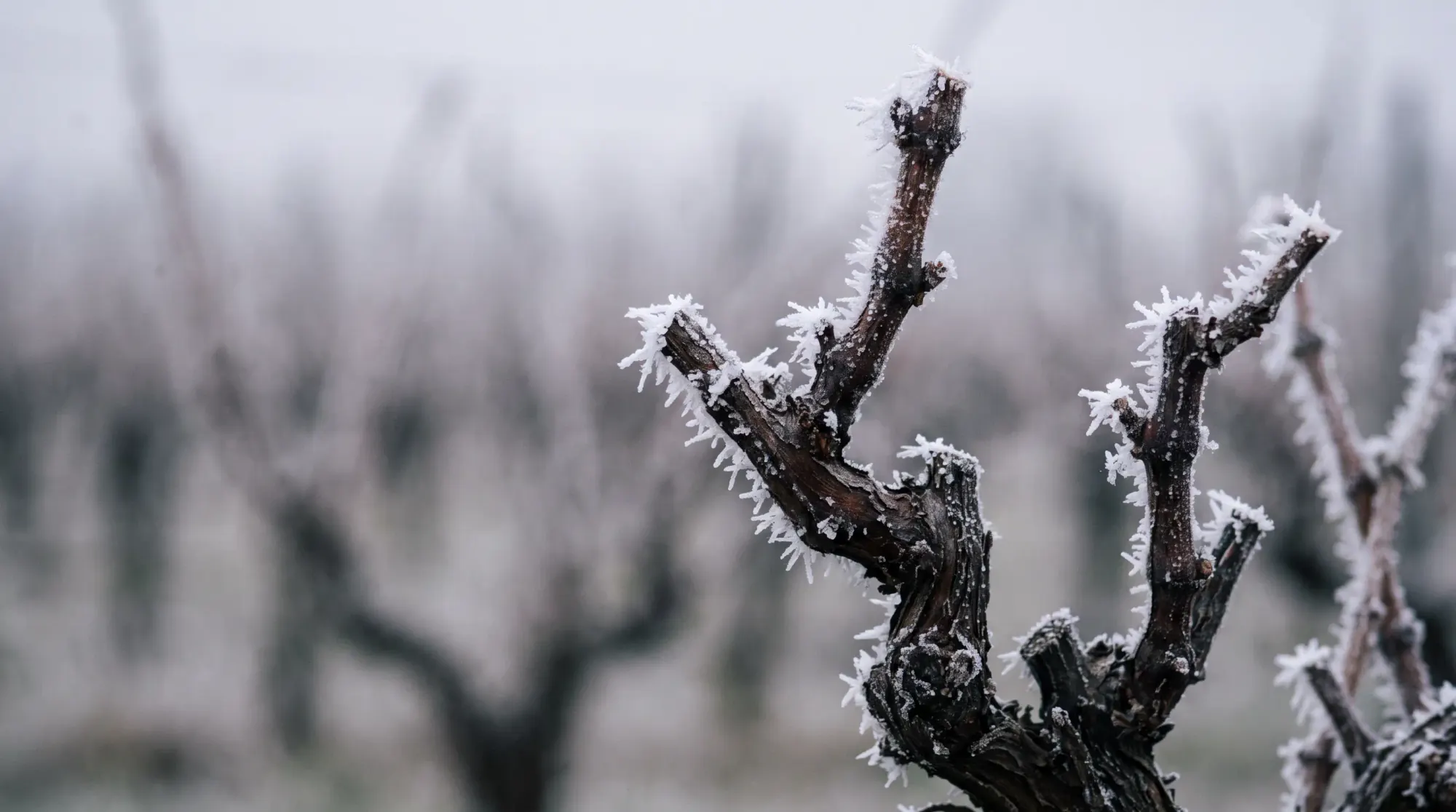
- Spring: highly variable. Spring frosts can hit the appellation in April or early May — one of the major climatic risks (see the destructive 1956 frost in our AOC history, or more recently the April 2017 event).
Thermal swing
The gap between daytime and nighttime temperatures regularly reaches 15 to 20 °C in summer on the causses. In the valley, the swing is smaller (10–12 °C). This thermal swing:
- slows ripening during cooler hours,
- preserves acidity in the berries,
- favours aromatic complexity,
- limits anthocyanin degradation (the pigments).
This is one of the factors that distinguishes Cadurcian Malbec from Argentinian Malbec, where thermal swing is even more pronounced (up to 25 °C in Mendoza) but within a drier environment.
Rainfall
Annual pattern
- Annual rainfall: 700 to 900 mm depending on zone (vs ~600 mm in Montpellier, ~950 mm in Bordeaux).
- Wettest season: spring (March–May) and autumn (October–November).
- Driest season: summer (July–August), sometimes 5–8 weeks without significant rain.
This rainfall is sufficient for the vine without being excessive — a balance appreciated by winemakers: no irrigation needed, but no systemic grey rot at the end of spring either.
Drought risk
Since 2017, episodes of prolonged summer drought have multiplied. 2018, 2019, 2022 and 2023 saw marked hydric stress, particularly on the lower terraces (free-draining soils, with an accessible but often distant water table). Winemakers adapt:
- measured cover cropping between rows to limit water competition,
- adapted pruning to reduce vine needs,
- plot-by-plot monitoring to anticipate hard hits.
The vines of the causses, paradoxically, withstand drought better: their roots plunge deep into the limestone fissures, where residual moisture is captured year-round.
Sunshine
- Annual sunshine hours: 2,000 to 2,200.
- This is slightly higher than Bordeaux (1,950 h) and lower than Montpellier (2,700 h).
- The Huglin heliothermal index classifies the Cahors AOC in the "warm temperate" category — well suited to Malbec, which demands heat to ripen.
Plot exposure plays an enormous role. On south-facing slopes (Caillac, Mercuès, Albas on the right bank), daily sunshine can exceed that of north-facing slopes by 1 to 2 hours — translating into ripeness advanced by 5 to 10 days.
Geology: a Jurassic bedrock
The major formation: Kimmeridgian limestone
The dominant bedrock of the AOC zone is Kimmeridgian limestone (Upper Jurassic, ~152 million years) and Bathonian limestone (Middle Jurassic, ~167 million years). These white-to-beige, friable rocks are the same formations that make up the Côte de Beaune in Burgundy or Chablis. They signal the minerality and freshness of the wines that grow above them.
The outcropping layers
| Formation | Period | Presence | Impact |
|---|---|---|---|
| Bathonian limestone | Mid-Jurassic (~167 Ma) | Central causses | Thin, stony, free-draining soils |
| Kimmeridgian limestone | Upper Jurassic (~152 Ma) | Western causses | Deeper clay-limestone soils |
| Portlandian limestone | Terminal Jurassic (~145 Ma) | Tops of the causses | Hard limestone benches, weak pedogenesis |
| Siderolithic | Tertiary (~40 Ma) | Pockets on the plateau | Localised red ferruginous soils (cf. Chambert) |
| Quaternary alluvium | Less than 2 Ma | Lot terraces | Gravels, sands, modern alluvium |
Alios, the distinctive cemented sandstone
On certain plots of the middle terraces, one finds beds of alios: a sand made compact by ferruginous cementation. It is an unusual, low-fertility soil that constrains the vine and concentrates the berries — sought after by several winemakers for prestige plot-specific cuvées.
Clay-limestone soils: the signature
The term clay-limestone is the descriptor most used to talk about Cadurcian soils. It designates a soil in which clay and limestone coexist in varying proportions:
- the clay retains water and nutrients — gives chew to the wine and ageing capacity,
- the limestone brings structure, minerality and acid freshness,
- their balance in the soil is the signature of great Cahors.
For a detailed zone-by-zone reading (causses, terraces, hillsides), see our terroir of the Cahors AOC page.
Synthesis table: soil, exposure, profile
| Configuration | Typical soil | Exposure | Wine profile |
|---|---|---|---|
| Causse, high plateau | Bedrock limestone, thin soil | Variable, south/east dominant | Concentrated, mineral, fresh, very long-finishing |
| Causse, sinkhole | Deep clay-limestone | Full sun | Rounder, firm structure, long cellaring |
| South-facing intermediate slope | Medium clay-limestone | Due south | Fast ripening, expressive, balanced |
| North-facing intermediate slope | Cool clay-limestone | Northwest | Fresh, elegant, preserved fruit |
| Third terrace | Rolled pebbles, free-draining | Full sun | Concentrated, complex, long potential |
| Second terrace | Mixed gravel/clay, alios | Full sun | Balanced, fruit-structured |
| First terrace | Recent silts and sands | Full sun | Supple, fruity, accessible young |
The impact of climate change
The evolutions of the past 20 years are measurable:
- Earlier harvests: average harvest date has moved 10 to 15 days earlier compared to the 1990s.
- Average alcohol level: +1 to 1.5° between the 1990-2000 average and the 2015-2025 average on "tradition" cuvées.
- Phenolic maturity faster, sometimes at the expense of aromatic expression.
- Heightened risks: paradoxically more frequent spring frosts (winter ends too mild), summer droughts, heatwaves.
Winemakers adapt their practices: clonal selection, rootstock choices, late pruning, shading via permanent cover cropping, nighttime harvests to preserve freshness. The path of resistant grape varieties is being explored for the long term, but remains marginal in the Cahors AOC, where Malbec is untouchable by definition.
Going further
These climatic and geological elements translate concretely into the glass. To move from theory to tasting, see:
- our vintage-by-vintage analyses from 2015 to 2025, detailing the specific climate impact of each year,
- our clay-limestone terroir of the Cahors AOC page on the three major zones,
- our winemaker profiles, where each estate describes the expression of its own terroir.
Sources: Météo-France · BRGM — French Geological Survey · IFV — French Institute of Vine and Wine · Wikipedia — Climate of the Lot · Vitisphere — climate and vineyards. Page updated 14 May 2026.
Alcohol abuse is dangerous for your health. Please drink responsibly.