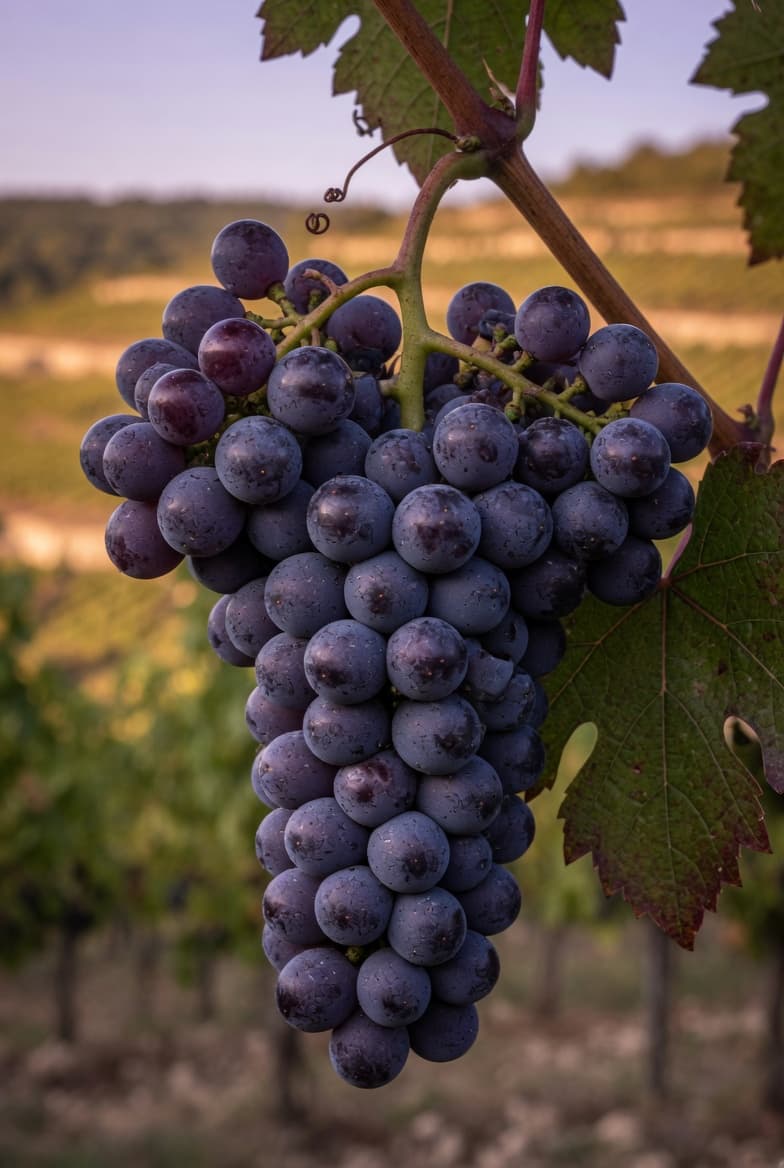
Malbec is the signature grape of the Cahors AOC. Locally called Auxerrois or Côt, it accounts for at least 70% of the blend required by the appellation rules, and around 85% on average today. It is what gives Cahors its deep colour, tannic structure, ageing potential and — today — its international fame, ever since Argentina adopted it in the 19th century as its leading grape.
This page revisits the characteristics of Malbec at Cahors: its origin, its synonyms, its organoleptic profile, its vineyard requirements and its exact role in the AOC. For general context, see our complete guide to the Cahors AOC.
A Cadurcian origin
Malbec is native to South-West France, more precisely to the banks of the Lot and the Tarn between Cahors and Gaillac. DNA analysis conducted in 2008 by José Vouillamoz and confirmed by INRA Montpellier established its precise genetic lineage: Malbec is the offspring of a spontaneous crossing between Prunelard (paternal parent, native to the Gaillac region) and Magdeleine Noire des Charentes (maternal parent). Since the latter is also the mother of Merlot, Malbec and Merlot are genetically half-brothers.
Its official French name — Malbec — is said, according to a tradition relayed by several ampelography works, to come from a winegrower named Malbeck or Malbek who propagated the grape in the Bordeaux region at the end of the 18th century. It is today the international designation, adopted by Argentina, the United States, Chile, Australia and every country that grows it.
At Cahors, it is still called Auxerrois or Côt — two local names that appear in viticultural literature from the 18th century onwards and remain in use among winemakers. An estate sheet or an old label is more likely to read "Auxerrois" than "Malbec".
Synonyms and possible confusion
| Name | Region of use | Note |
|---|---|---|
| Malbec | International, France | Official and most widely known name |
| Auxerrois | Cahors, South-West | Local synonym, no connection with the white Auxerrois of Alsace/Luxembourg |
| Côt (or Cot) | Loire, Cahors | Widely used in Touraine where it makes light reds |
| Pressac | Bordeaux (rare) | Old Bordelais name, still mentioned in some AOCs |
| Noir de Pressac | Historic Bordeaux | Variant of the above |
Warning: "Auxerrois blanc" (a grape from Alsace and Luxembourg) has no connection with the red Auxerrois of Cahors. Same name, completely different grape. This homonymy regularly confuses wine lovers.
Vineyard characteristics
In the vine
Malbec is a grape that is:
- vigorous but sensitive to over-cropping: left to overload, it produces lean, acidic wines;
- early-budding: it bursts buds early in spring, making it vulnerable to spring frost (the 1956 frost, or more recently April 2017, caused considerable damage);
- sun-demanding: it needs heat to properly ripen the anthocyanins (red pigments) and tannins;
- drought-resistant in the poor, free-draining soils of the causses (where its roots plunge deep);
- prone to coulure and millerandage under cool flowering — which can affect yields.
Ripening at Cahors takes place between mid-September and mid-October, depending on terroirs and vintages. The causses often harvest later than the valley (by 10–15 days).
Yields
The AOC specifications cap yields at 50 hl/ha as a general rule. In practice, the better cuvées sit around 35–45 hl/ha, and prestige cuvées drop to 25–30 hl/ha to gain concentration.
Organoleptic characteristics
In the eye
Malbec's colour is one of the deepest in the wine plant kingdom. On a young Cahors, the term used is almost opaque violet-red: you cannot see through the glass. This chromatic density comes from an anthocyanin (red pigment) concentration higher than most French grapes — which earned Cahors its medieval nickname "black wine".
With ageing, the colour evolves towards dark ruby, then garnet, and tile-tinged on very old bottles (15–20 years+).
On the nose
Malbec at Cahors develops three main aromatic families:
- Fresh black fruits: blackcurrant, blackberry, fresh plum, black cherry.
- Floral and spicy notes: violet, iris, black pepper, cinnamon, garrigue.
- Evolution (4–10 years+): stewed prune, dried fig, cocoa, light tobacco, leather, undergrowth.
Cool terroirs (causses, north-facing slopes) accentuate floral and spicy freshness. Warm terroirs (south-facing terraces, valley) accentuate cooked black fruit and more solar notes.
On the palate
The typical profile combines:
- a full, fruity attack,
- a dense mid-palate, marked by firm but structuring tannins,
- acid freshness balancing the richness,
- a long finish, on black fruits and spices.
Young Cahors Malbec can seem austere: this is the caricatured reading of the "big tannic Cahors". On well-crafted cuvées, this youthful austerity transforms, after 5–8 years, into complex elegance.
The role within the Cahors AOC
The 70% minimum rule
The specifications require 70% Malbec minimum in the final blend. The remaining 30% can be made up of:
- Merlot: brings fruit, suppleness, rounds the tannins. Heavily used in entry-level and mid-range cuvées.
- Tannat: brings structure, body, powerful tannins. Rarer, mostly in prestige cuvées.
No other red grape is authorised. Actual blends average around 85% Malbec, 10% Merlot, 5% Tannat. 100% Malbec cuvées have become more common since the 2000s, driven by international demand and by several winemakers' conviction that the Cadurcian grape is sufficient unto itself.
For details on blends and a list of emblematic 100% Malbec cuvées, see our article 100% Malbec: the pure cuvées of Cahors.
Why 70% and not 100%?
The 70% rule was a political compromise in 1971: it protected Malbec's identity without banning Merlot, already widespread after the 1956 frost. This threshold remains relevant today for two reasons:
- it leaves flexibility to winemakers in difficult vintages (frost, coulure, uneven ripening),
- it preserves the stylistic diversity of the appellation, without imposing a monoculture.
Cahors vs Argentinian Malbec: key differences
The Malbec planted in Argentina comes directly from Cahors — the French agronomist Michel Aimé Pouget introduced the grape there on 17 April 1853, when he founded the Quinta Normal de Mendoza at the invitation of governor Pedro Pascual Segura. Yet the result in the glass is very different. For detail, see our 7-criterion comparison.
In summary:
- Tannins: more present and structuring at Cahors; more enveloped in Argentina.
- Freshness: preserved at Cahors by cool nights and the natural acidity of a semi-continental climate; more exotic in Argentina, where the climate is very dry and solar.
- Aromatics: fresh black fruits, violet, spices, cocoa at Cahors; jam, vanilla, stewed plum in Argentina.
- Ageing: largely in foudres, concrete vat and barrel (often used) at Cahors; new barrel common in Argentina.
- Cellaring: higher potential on Cadurcian grands crus (15–25 years) than on average Argentinian Malbec (5–15 years).
This comparison is neither a value judgement nor a ranking — both styles are legitimate and express their respective terroir.
Malbec around the world
Beyond Cahors and Mendoza, Malbec is now grown in several countries:
- United States: California (Sonoma, Napa for Bordeaux-style blends), Washington State (emerging pure-Malbec).
- Chile: mostly in the central valley, where it blends with Cabernet Sauvignon.
- Australia: a tiny share, but a few emerging pure-Malbec (Margaret River).
- South Africa: marginal, growing.
- Loire (France): under the name Côt, mainly in Touraine in light cuvées.
For a full panorama, see our article Malbec around the world.
Spotting a Cahors blind
Five clues often help identify a Cahors in a blind tasting:
- Colour: very dark, almost opaque, thick tears — the Malbec signature.
- Nose: fresh black fruits and notes of violet or garrigue (Argentina leans towards cooked fruit and vanilla).
- Palate acidity: present, structuring — more pronounced than on most foreign Malbec.
- Tannins: firm but with a characteristic mineral framework of limestone soils.
- Finish: long, on cocoa or liquorice, rather than vanilla or ripe strawberry.
Our article spotting a Cahors blind goes deeper into the exercise with concrete examples and a comparative tasting protocol.
Sources: Wikipedia — Malbec (grape) · Wine Grapes (Robinson, Harding, Vouillamoz, 2012) · IFV — French Institute of Vine and Wine · Decanter — Malbec history. Page updated 14 May 2026.
Alcohol abuse is dangerous for your health. Please drink responsibly.