Contents
Cahors wine is one of the great reds of the French South-West, produced in the Lot Valley from a grape that has become famous the world over: Malbec. Known since the Middle Ages as "black wine" for its near-opaque colour, it has been enjoying a qualitative revival for fifty years that has placed the appellation among France's Malbec benchmarks — long before Argentina made it their signature grape.
This guide offers a complete reading of the AOC: its history, its clay-limestone terroir, its grape, its 45 villages, its leading winemakers, its vintages, its prices and the food pairings that show it at its best. This is the pillar page of the site, updated with every major evolution of the appellation.
The Cahors AOC in figures
| Data | Value |
|---|---|
| Recognition decree | 15 April 1971 (Official Journal 18 April 1971) |
| AOC area in production | ~2,000 hectares (2022-2024 average) |
| Initial AOC area (1971) | 440 hectares |
| Trade body | UIVC (Union Interprofessionnelle du Vin de Cahors), created in 1989 |
| Average annual production | ~160,000 hectolitres (varies by vintage) |
| Principal grape | Malbec or Côt N (minimum 70%) |
| Authorised blending grapes | Merlot N, Tannat N |
| Maximum yield | 50 hl/ha (60 hl/ha buffer) |
| Minimum planting density | 4,000 vines/ha |
| Wine colour produced under AOC | Red exclusively |
| Authorised communes | 45 villages of the Lot, around the Lot Valley |
| Share of production exported | ~30% (42,981 hl in 2017) |
| Main export markets | United Kingdom, Belgium, United States, Germany, Canada |
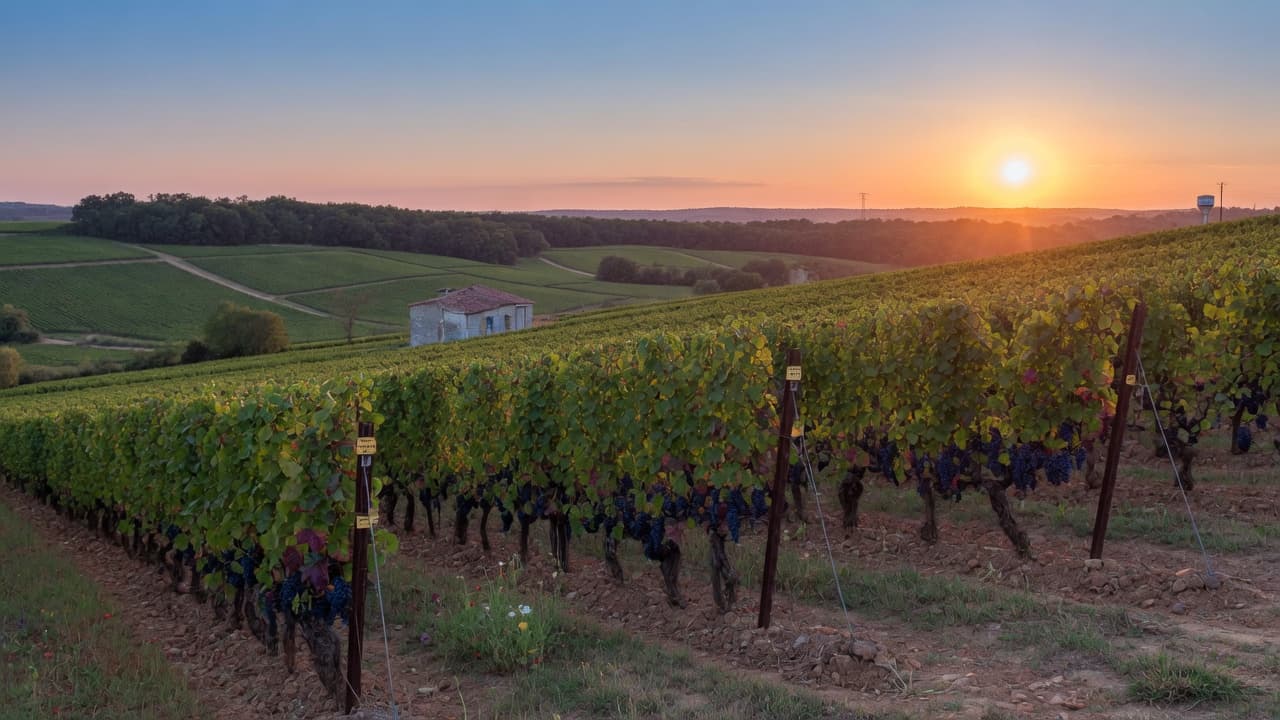
The vineyard stretches across both banks of the Lot, from Cahors in the east to Soturac at the Lot-et-Garonne border. It is framed by the limestone causses of the Quercy to the south and the north — a landscape that defines both the wine's character and its resistance to phylloxera at the end of the 19th century.
What is Cahors wine?
Cahors wine is a still red wine produced in the controlled appellation area of Cahors, in the heart of the Quercy. Its singularity rests on three pillars: the Malbec grape, the clay-limestone terroir of the Lot Valley and the Quercy causses, and a tradition of long macerations that gives the wine its dark colour and tannic frame.
The appellation requires a minimum of 70% Malbec in the blend. The remaining 30% may be made up of Merlot (bringing fruit and suppleness) and/or Tannat (adding structure and depth). Many estates now produce 100% Malbec cuvées, to showcase the purity of the king grape.
The aromatic profile of a balanced Cahors combines:
- black fruits (blackcurrant, blackberry, cooked plum) on the first nose,
- notes of violet, garrigue and soft spices on cooler terroirs,
- nuances of cocoa, light tobacco and leather with age,
- a dense, structured palate, supported by firm tannins in youth that melt with time.
To understand how this profile takes shape, see our complete terroir guide of the Cahors AOC and our Malbec grape analysis at Cahors.
Why is Cahors called the "black wine"?
The expression "black wine" goes back to the Middle Ages. At that time, the extremely deep colour of Malbec — more opaque than other French reds — made it appear almost black in the pewter glasses of the era. The term took hold in the 13th century, when Cahors was massively exported from Bordeaux to England, the Hanseatic League and the courts of Northern Europe.
This is not retrospective marketing: the mention appears in commercial correspondence and in the inventories of England's royal cellars. According to local tradition relayed by several historical sources, Cahors was reportedly served at the wedding of Eleanor of Aquitaine and Henry II Plantagenet in 1152 (not 1154, the date of coronation). Bordeaux's commercial archives, however, very clearly document the intense traffic of "haut pays wine" throughout the Plantagenet period (12th–13th centuries).
For the full context of this medieval adventure, see our detailed history of the Cahors AOC.
Malbec, the signature grape of Cahors
Origin and synonyms
Malbec is native to the French South-West. At Cahors, it bears the local names of Auxerrois and Côt (sometimes written Cot). In the Bordeaux region, it is known as Pressac. These synonyms are useful when reading old sources or speaking with a winemaker who still uses local terminology.
It is from Cahors that it spread across the world. On 17 April 1853, the French agronomist Michel Aimé Pouget (born 1821) was invited to Mendoza by the governor Pedro Pascual Segura to found the Quinta Normal de Mendoza, an agronomy school where he introduced French grape varieties — including Malbec. They adapted remarkably well in the Andean foothills — giving rise, more than a century later, to the Argentinian Malbec that now dominates the world market. 17 April is now celebrated as Malbec World Day. To understand what distinguishes the two styles, we have dedicated a comparison article: Cahors vs Argentinian Malbec: 7-criterion comparison.
Organoleptic characteristics
At Cahors, Malbec stands apart from its Argentinian cousins by:
- a more present tannic structure, inherited from traditional long macerations;
- a more pronounced acid freshness, due to the semi-continental climate and cool nights on the causses;
- an aromatic profile oriented towards fresh black fruits, violet, cocoa and spice — where Argentina often pushes towards jam, vanilla and new oak;
- a higher cellaring potential on the longer-ageing cuvées (15 to 25 years for grands crus), thanks to this tannin/acidity balance.
Why 70% minimum?
The 70% Malbec rule was written into the AOC specifications in 1971. It protects the identity of Cahors against the temptation, at the time, to raise yields by planting more Merlot. Today, the appellation average sits around 85% Malbec in the blend, and many cuvées are 100%. For technical detail, see the Malbec grape at Cahors page.
The terroirs of the Cahors AOC
The vineyard unfolds across three major geological zones, each producing a different style of Cahors. This diversity makes the appellation rich, and justifies the ongoing project to classify Premier Cru sites in the Lot.
The terraces of the Lot Valley
Closest to the river lie the alluvial terraces deposited by the Lot in the Quaternary. These are gravel-and-pebble soils, free-draining, that warm quickly in the sun. Three levels are distinguished: the first terrace (lowest, fertile soils, fruity and accessible wines), the second terrace (mixed gravel/clay soils, tannin/fruit balance), the third terrace (poorest and most free-draining soils, concentrated wines with strong cellaring potential).
Most of the great Cahors cuvées are found on terraces 2 and 3.
The limestone causses of the Quercy
Rising above the valley are the causses — plateaus of Kimmeridgian and Bathonian limestone, with poor stony soils, fully exposed to the sun. The climate here is more continental, with cool nights preserving acidity. Yields are naturally low. The wines from the causses are the most tannic and the slowest to come together: a great causse Cahors often needs 8 to 12 years before reaching its peak. Clos de Pougette, at Cournou, is a representative example.
The intermediate slopes
Between the valley and the causses, the intermediate slopes offer a compromise: deeper clay-limestone soils, variable exposure depending on aspect, local microclimates. Many historic estates sit on these slopes, which yield balanced, expressive Cahors capable of ageing well without reaching the power of the causses.
For a detailed map and comparative table of the three zones, see our dedicated page on the terroir of the Cahors AOC and our analysis of climate and soils.
How to recognise a great Cahors?
Identifying a great Cahors happens in three stages — as for most cellaring wines.
To the eye: the colour
A young Cahors shows an intense, almost opaque violet-red. With age, it evolves towards dark ruby, then tile-edged garnet. A thick, slow tear suggests careful vinification and dense structure — though that alone does not guarantee quality.
On the nose: expression
On a young Cahors (3–5 years), expect:
- fresh black fruits (blackcurrant, blackberry, plum),
- floral notes (violet, iris),
- a touch of soft spices (black pepper, cinnamon),
- possibly a hint of oak if the cuvée was aged in barrel.
On an evolved Cahors (8–15 years), the bouquet enriches:
- cooked black fruits, prune, fig,
- cocoa, light tobacco, leather,
- undergrowth, garrigue, truffle on the finest bottles.
On the palate: the structure
A great Cahors balances density, freshness and length. Tannins should be present but never aggressive; acidity present without dominating; the finish long, on complex aromas. If the wine feels merely "rustic and tannic", it is not a great Cahors.
For more on tasting, see our article spotting a Cahors blind in 5 clues.
The leading winemakers and estates of Cahors
The appellation counts around 200 independent winemakers and one reference cooperative (Les Côtes d'Olt). Our editorial team lists the 16 essential estates in 2026 that form the backbone of qualitative production.
Historic estates
- Clos Triguedina (Jean-Luc Baldès), family estate that was one of the engines of the Cahors revival in the 1970s. The "Probus" cuvée is a benchmark.
- Château du Cèdre (Pascal and Jean-Marc Verhaeghe), at Vire-sur-Lot, 27 ha in organic farming (conversion engaged from the early 1990s), recognised for the purity of its Malbec.
- Château Lagrézette (Perrin family — founder Alain-Dominique Perrin, former CEO of Cartier, transmission to his daughter Sonia Perrin in December 2025), at Caillac, 90 ha in HVE level 3. The "Le Pigeonnier" cuvée (2.7 ha plot, first vintage 1997, ~6,500 bottles/year, 28 months in new French oak) is the estate’s flagship cuvée.
Reference estates on the causses
- Clos de Pougette (Pierre Benac), at Cournou (Saint-Vincent-Rive-d'Olt). Family organic estate of 23 hectares on the causse, certified Agriculture Biologique and HVE, practising kunekune pig pasture between rows — a rare regenerative approach in the South-West. Pilot profile of the site.
- Cosse-Maisonneuve (Matthieu Cosse and Catherine Maisonneuve), at Lacapelle-Cabanac, 20 ha in Demeter biodynamics since the start (1999), a figurehead of biodynamics at Cahors.
- Château de Chambert (Philippe Lejeune), large 65-ha estate on the Floressas causse, Ecocert biodynamic certified since 2009 + Demeter. With a Michelin-starred restaurant.
Biodynamic estates and new generation
- Mas del Périé (Fabien Jouves), at Trespoux-Rassiels. Uncompromising style, biodynamics, meticulous vinifications.
- Maison Georges Vigouroux, négociant and properties, one of the largest actors in the appellation.
- Château de Gaudou (Durou family), at Vire-sur-Lot.
For the full list of 16 referenced estates and their detailed profiles, see our directory of Cahors winemakers.
Cahors vs Argentinian Malbec: the real difference
This is probably the most asked question by wine lovers across the world: what distinguishes a Cahors from a Mendoza Malbec? The answer is held in seven criteria detailed in our Cahors vs Argentinian Malbec comparison — here is the summary.
| Criterion | Cahors (France) | Argentinian Malbec (Mendoza) |
|---|---|---|
| Average altitude | 100 to 350 m | 900 to 1,500 m |
| Climate | Semi-continental, oceanic | Dry continental, sunny |
| Soils | Clay-limestone, alluvium, causses | Sandy alluvium, gravel |
| Tannins | Present, structuring | Suppler, more enveloped |
| Aromatic profile | Fresh black fruits, spices, cocoa | Jam, vanilla, ripe plum |
| Typical ageing | Foudre, concrete vat, barrel (rarely new oak) | New barrel common |
| Cellaring potential | 10 to 25 years for great cuvées | 5 to 15 years generally |
In one sentence: Cahors is a more tannic and fresher cellaring wine, Argentinian Malbec is more fruity and more accessible young. One is not better than the other — they tell two different stories of the same grape.
Which vintages to buy in 2026?
For the last ten years, here is the vintage-by-vintage reading at Cahors:
- 2015 ★★★★ Solid, structured, drink or hold.
- 2016 ★★★★ Great vintage, balanced, long cellaring (to 2035 on the longer-ageing cuvées).
- 2017 ★★ Severe spring frost, reduced production. Uneven — avoid except for cuvées from well-protected estates.
- 2018 ★★★★ Generous, mature vintage, drink within the next 10 years.
- 2019 ★★★★ Fine classic vintage, freshness preserved, cellaring 12–15 years.
- 2020 ★★★★★ Exceptional vintage, concentration and freshness, long cellaring.
- 2021 ★★★ Cool year, elegant but less concentrated wines. Drink within 8–10 years.
- 2022 ★★★★ Very hot, solar and powerful wines. Watch the alcohol.
- 2023 ★★★ Uneven, judge cuvée by cuvée.
- 2024 Still in élevage — analysis to be published on our dedicated pages.
For year-by-year detail, see our Cahors vintage guide and our individual vintage pages.
Food and wine pairings: what to drink with a Cahors?
Cahors shines with South-West cuisine but also welcomes more contemporary pairings successfully. Here are the classics and a few avenues to explore.
The essential regional pairings
- Cassoulet and Cahors: the ultimate regional pairing, where the tannic structure of Malbec cuts the confit richness of sausages, magrets and beans.
- Duck confit: the controlled bitterness of the tannin balances the fat of the confit.
- Duck magret: with a young Cahors if the sauce is fruity, more evolved (8–10 years) if the sauce is complex.
- Ceps and Quercy black truffle: a great autumn pairing on a mature Cahors.
- Stuffed Agen prunes: a Lot classic, echoing the prune notes of evolved Malbec.
More modern pairings
- Mature cheeses: farmhouse Rocamadour, aged Cantal, Roquefort on a cellared Cahors.
- Lamb tagine with prunes: Moroccan spices match the cocoa and spice notes of Malbec.
- Dark chocolate 70%+: daring but successful on a mature, fruity Cahors.
Our complete pairing guide with Cahors details every food family.
Where to buy Cahors wine?
Direct from the estate
This is the most authentic route: you taste before buying, you exchange with the winemaker, and you sometimes find cuvées not distributed in mass retail. Most estates in the appellation welcome visitors by appointment or open days. See our winemaker events calendar.
From wine merchants
Independent wine merchants in major French cities almost all carry at least a few Cahors references. Ask for causse estates and second-terrace wines — that is where the best gems hide.
Online
Several French e-commerce sites list hundreds of Cahors:
- Vinatis, iDealwine, Millesima for grands crus and auctions.
- Cavissima and Twil for independent estates.
- The cooperative sites (notably Les Côtes d'Olt) for estate cuvées sold direct.
For export
United Kingdom: Berry Bros, Lay & Wheeler, The Wine Society. United States: Kermit Lynch, K&L Wine Merchants. Germany: Hawesko, Riegel. Belgium: Cinoco, Marsis.
Prices: what to expect by tier
| Tier | Indicative price (ex-estate) | Profile |
|---|---|---|
| Entry-level | €7 – €12 | Generic Cahors, simple vinification, fruity, drink young |
| Tradition | €12 – €18 | Good representation of the appellation, tannin/fruit balance |
| Prestige | €18 – €30 | Careful ageing, identified terroir, cellaring 10 years+ |
| Grand cru du Lot / single-plot | €30 – €60 | Major plots, long ageing, cellaring 15–20 years |
| Rare prestige cuvées | €60 – €120 | Very small runs, editorial prestige |
The appellation's average value remains excellent: at Cahors, you find at €15–€20 what would cost €30–€40 in a media-covered Bordeaux appellation. This is one of the reasons our editorial team believes in significant export potential for the years to come.
Our 2026 buying guide details the ranges by budget, occasion and cellaring profile.
The site's editorial line
Malbec has found its original terroir there, and several generations of winemakers have rebuilt, since 1971, what had been dismantled by the 1956 frost and phylloxera before. We believe the next ten years will be decisive: Premier Cru du Lot classification project, rise of biodynamic cuvées, increased export to Anglo-Saxon and Spanish-speaking markets.
Our editorial line: document the appellation from public, verifiable sources. We do not taste the wines and do not rate them; the assessments we reproduce are those of their authors, quoted as such.
— The editorial team of vin-de-cahors.fr
Frequently asked questions about Cahors wine
What is the best Cahors wine?
There is no single "best" Cahors: it all depends on budget and style. Among the cuvées documented on this site: Château Lagrézette "Le Pigeonnier" (prestige top tier), Clos Triguedina "Probus" (historic benchmark), Château du Cèdre "GC" (Grand Cru, Malbec purity in organic farming), Mas del Périé "Les Acacias" (uncompromising biodynamic style). For selections by budget, see our Cahors wines singled out by the guides.
Why is Cahors called the "black wine"?
The extremely deep colour of Malbec gave the wine, in the Middle Ages, an almost opaque appearance compared to other French reds. The expression "black wine" appears in 13th-century commercial correspondence, when Cahors was exported in quantity via Bordeaux to England. It has remained a marker of the appellation's identity. For full historical context, see our history of the Cahors AOC.
Which grape is used for Cahors?
The principal grape is Malbec (locally called Auxerrois or Côt), at 70% minimum under the AOC specifications. The blend may be completed with Merlot and/or Tannat. Many cuvées are 100% Malbec. Our Malbec at Cahors page details the history and profile of this emblematic grape.
How long does Cahors keep?
Cellaring duration depends on the cuvée tier:
- Entry-level and Tradition cuvées: 3 to 8 years after vintage.
- Prestige cuvées: 8 to 15 years, sometimes more depending on the vintage.
- Lot grands crus and single-plot causse cuvées: 15 to 25 years, exceptionally more.
The tannic structure and natural acidity of Malbec favour good ageing. Our article on Malbec ageing goes deeper.
What is the difference between Cahors and Argentinian Malbec?
In summary: Cahors is more tannic, fresher, and structured for cellaring; Argentinian Malbec (notably from Mendoza) is more fruity, more supple and more accessible young. The clay-limestone terroir of Cahors and the semi-continental climate of the Quercy produce a very different style from Andean altitude and the dry climate of Mendoza. Our detailed 7-criterion comparison goes deeper.
How much does a good Cahors cost?
From €12 to €18, you already find excellent Cahors ready to drink or to keep 5 to 8 years. For a prestige Cahors (single-plot, old Malbec, long ageing), budget €18 to €30. Lot grands crus and rare cuvées rise to €30 to €80, exceptionally more. Our guide "How much does a good Cahors cost?" details each tier with concrete examples.
What food pairs with Cahors?
The most successful pairings:
- Cassoulet, duck confit, magret — the great South-West classics.
- Grilled red meats, game, lamb — for the tannic structure.
- Ceps, Quercy black truffle — on a mature Cahors.
- Mature cheeses (Rocamadour, aged Cantal, Roquefort).
Our Cahors food and wine pairing guide details dozens of combinations by food family.
Where is Cahors located?
The Cahors AOC sits in the Lot department, in the Occitanie region, in the south-west of France. The appellation area extends around the Lot river, across 45 communes framed by the causses of the Quercy. For the full list of communes, see our communes of the appellation page.
Is Cahors a tannic wine?
Yes, Cahors is a structured wine by nature, with tannins more present than an entry-level Beaujolais or Côtes-du-Rhône. But this structure is not synonymous with aggressiveness: on good cuvées, the tannins are firm but silky, melting with a few years of cellaring. Entry-level Cahors are often drunk within 3–5 years, when the tannins are already well integrated.
Which Cahors vintage should I choose?
To drink in the coming months, lean towards 2018, 2019 or 2020: these vintages are at the heart of their drinking window. For the cellar, 2016 and 2020 are the picks on cellaring cuvées. Avoid 2017 (severe frost) unless buying a cuvée from a well-protected estate. Our Cahors vintage guide details every year from 2015 to 2025.
Reference sources and further reading: Wikipedia — Cahors wine · Decanter — Cahors wine guide · Vitisphere — wine news · La Revue du Vin de France · Hachette Vins
Page updated 14 May 2026 by the vin-de-cahors.fr editorial team.
Alcohol abuse is dangerous for your health. Please drink responsibly.