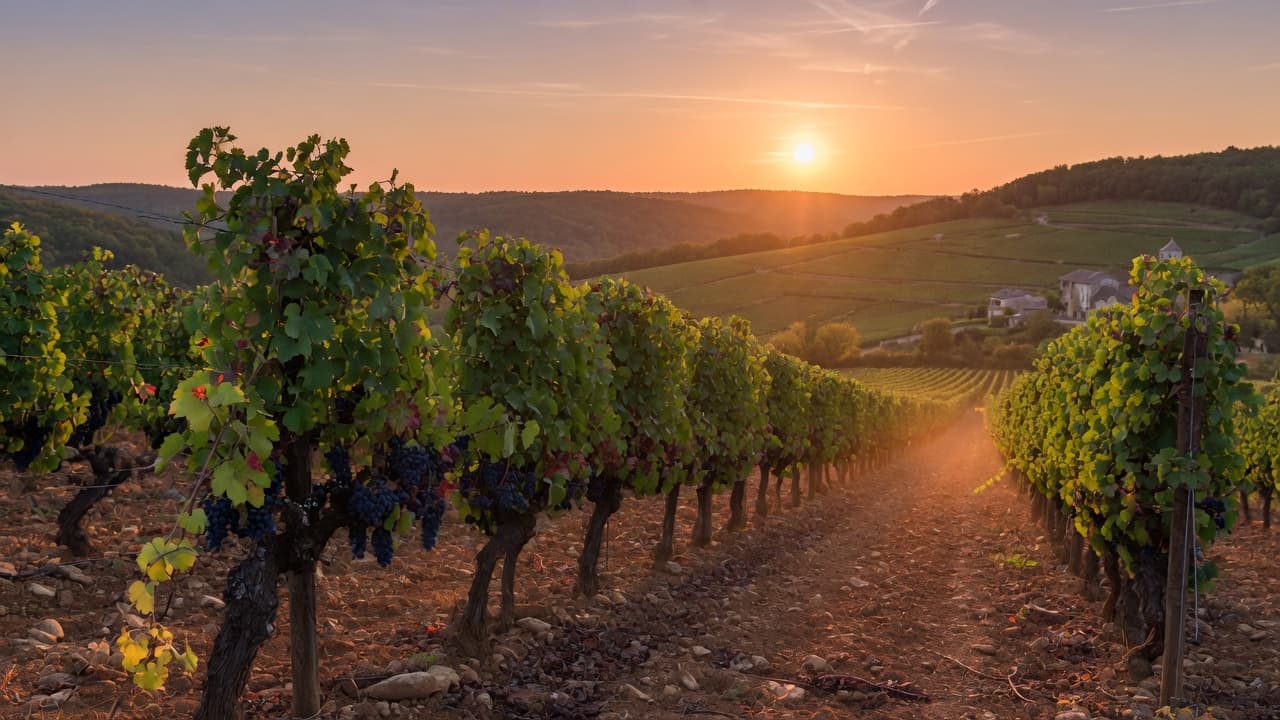
Vintage matters more in Cahors than in most French appellations. The region sits at a climatic crossroads — semi-continental, open to Atlantic influence, and exposed to spring frost — which produces swings from one year to the next that are sharper than in Bordeaux or Provence. This is our complete 2015-2025 guide, year by year, with weather, wine profile, drinking window and the cuvées worth seeking out.
How we rate : our ★ to ★★★★★ scale combines three inputs — (1) the objective growing-season conditions (rainfall pattern, temperatures, frost events), (2) what we actually taste across the cuvées released by our reference estates, and (3) scores published by French and international specialist guides. We use no aggregator averages: every vintage is read cuvée by cuvée. Our verdict can therefore diverge from consensus when the Cahors terroir responds differently from other French regions to the same weather event. That fine-grained weather data — rainfall, temperature, frost — is also exactly what precision viticulture now measures plot by plot.
The decade at a glance : two outstanding vintages (2016 and 2020), four solid ones (2015, 2018, 2019, 2022), two to drink young rather than cellar (2021, 2023), one write-off (2017 — severe frost), one still being judged (2024) and one too young to call (2025). On balance a good decade for Cahors, despite mounting pressure from climate change. For the geology and climate that underpin these readings, see our climate and soils of the Cahors AOC. For general background, see our complete guide to the Cahors AOC.
Summary table
| Vintage | Rating | Profile | Drink now | Cellar |
|---|---|---|---|---|
| 2025 | Watch | Still in barrel | — | Worth en primeur on top crus |
| 2024 | In élevage | Fresh to ripe by zone | — | Reassess late 2026 |
| 2023 | ★★★ | Uneven | Estate cuvées | Not really |
| 2022 | ★★★★ | Sun-drenched, powerful | Estate cuvées | Prestige cuvées |
| 2021 | ★★★ | Fresh, elegant, short | Now to 2030 | Not ideal |
| 2020 | ★★★★★ | Exceptional, complete | 2027-2040 | Top crus |
| 2019 | ★★★★ | Classical, fresh | Now to 2034 | Good cuvées |
| 2018 | ★★★★ | Ripe, generous | Now to 2032 | Estate cuvées |
| 2017 | ★★ | Severe frost, thin | Très hétérogène | No | |
| 2016 | ★★★★ | Great vintage | Now to 2035 | Prestige cuvées |
| 2015 | ★★★★ | Solid, structured | Now to 2033 | Good cuvées |
Vintage by vintage
2025 — One to watch
Weather : hot dry summer, early harvest from late August into early September. Average yields. Expected profile : sun-driven wines; the acidity-to-alcohol balance is the thing to watch. Strategy : wait for post-élevage assessments before buying. En primeur on the top crus can be worthwhile if pricing stays sensible.
2024 — Still in élevage
Weather : late spring, mixed summer, wet autumn. Late harvest in mid-October. Expected profile : variable by zone. The limestone causses ran cooler than the river terraces. Reassess in 2026-2027 once bottled.
2023 — Uneven (★★★)
Weather : cool spring, hot summer turning wet in late August, harvest dates scattered by zone. Profile : fresh wines with fruit that did not always fully ripen, and very uneven quality between estates and even between plots. Choose cuvée by cuvée rather than trusting the appellation. Causses vs terraces : the causses came off better — natural drainage against the late-summer rain, and slower ripening that preserved freshness. The lower terraces struggled to ripen fruit, and several entry-level cuvées lack concentration. Our advice : stick to the estate cuvées of the major producers (Cèdre, Chambert, Cosse-Maisonneuve). Skip the entry-level bottlings.
2022 — Sun-drenched and powerful (★★★★)
Weather : very hot summer with a July-August heatwave, early harvest in late August. Water stress on the lower terraces; quality held on the causses, where roots run deep. Profile : dense, powerful wines, often high in alcohol — 14 to 14.5 % on average for Tradition cuvées, sometimes more on the causse Prestige bottlings. Ripe tannins, cooked fruit. Balance is the thing to check. Causses vs terraces : the causses delivered one of their best recent vintages here — freshness held despite the heat, with fully resolved tannic structure. The lower terraces are sunnier, occasionally jammy, and need choosing with care. Drink : estate cuvées are ready now. Prestige cuvées: wait until 2027-2028. Some cuvées from this vintage : Chambert "Château de Chambert", Cèdre "Le Cèdre", Cosse-Maisonneuve "Le Combal".
2021 — Fresh and elegant, short (★★★)
Weather : April spring frost cut production by 15-25 % depending on the zone, followed by a cool summer and a textbook autumn. Profile : fresh, elegant, less concentrated wines than the ripe vintages. Acidity intact, fine-grained tannins. Not a cellaring vintage, but a pleasure to drink young. Causses vs terraces : unusually consistent across the appellation, with slightly riper fruit on the best-exposed slopes. The causses produced their most taut expression of the decade. Drink : now and over the next five to seven years. Not one for long-term cellaring. Some cuvées from this vintage : Mas del Périé "Les Acacias", Cèdre "Le Cèdre".
2020 — Exceptional (★★★★★)
Weather : ideal conditions — a mild spring with no destructive frost, a warm summer without excess, and a dry, gentle autumn. September harvest with perfectly ripe fruit. Profile : complete, balanced wines combining concentration and freshness. The benchmark vintage of the 2020s so far. Causses vs terraces : for once the entire quality range succeeded, from entry-level bottlings to the top causse crus. Our editorial team did not find a single poorly made 2020 among our reference estates. Worth knowing : Château du Cèdre's GC 2020 was rated 95/100 by James Suckling. Drink : the Prestige cuvées are already superb but want a few more years. Expected peak: 2030-2040 for the top crus. Some cuvées from this vintage : Lagrézette "Le Pigeonnier", Triguedina "Probus", Cèdre "GC", Chambert "Grand Vin".
2019 — Classical and fresh (★★★★)
Weather : textbook conditions, moderate summer, ideal autumn. Harvest in late September. Profile : balanced, fresh, expressive wines. Good phenolic ripeness with acidity intact. A "technical" vintage that sommeliers rate highly. Causses vs terraces : little separates the two zones — one of the vintages where the appellation speaks with a single voice. The entry-level cuvées are unusually good for the decade. Drink : estate cuvées are in the heart of their window. Prestige cuvées have another four to six years ahead. Some cuvées from this vintage : Cosse-Maisonneuve "Le Combal", Cèdre "GC", Gaudou "Renaissance".
2018 — Ripe and generous (★★★★)
Weather : cool spring, hot summer, ideal autumn. Harvest from late September into mid-October. Generous yields. Profile : generous, ripe, approachable wines. Compact black fruit, ripe tannins. A very good vintage to drink over the next five to ten years. Causses vs terraces : 2018 is the terraces' vintage — vivid fruit, alcohol under control, immediately readable. The causses are more austere in youth and need a few years to open. Drink : estate cuvées are at their peak. Prestige cuvées: open gradually from 2026. Some cuvées from this vintage : Triguedina "Probus", Lagrézette "Le Pigeonnier", Chambert "Grand Vin".
2017 — Severe frost (★★)
Weather : a destructive frost in late April 2017 — a −7 °C (19 °F) episode that wiped out 60 to 80 % of the crop in some zones. A decent summer for what survived. Profile : minimal production and very uneven quality. On the few spared plots the wines are respectable. Elsewhere, better to pass. Causses vs terraces : the most frost-exposed plots — often the lower terraces — took the worst of it. The causses, slightly higher and better ventilated, sometimes saved the essential. A handful of 2017 causse cuvées are remarkable, but they are the exception. Worth knowing : the night of 26-27 April 2017 remains etched into the appellation's memory. Growers lit anti-frost candles and ran mobile wind machines to stir the air, without always holding back the temperature drop. Emergency vinifications on the few surviving berries occasionally produced unique one-off cuvées in runs of a few hundred bottles. Drink : only cuvées from well-sheltered estates, generally on the causses. Avoid the lower terraces. Our advice : skip this vintage unless the bottle comes from an estate you know and trust.
2016 — A great vintage (★★★★)
Weather : late spring, sunny summer without excess, ideal harvest in late September. A complete growing season. Profile : dense, balanced wines built for the cellar. Plenty of structure with freshness intact. The long-ageing reference. Causses vs terraces : the causses produced their most accomplished expression of the 2010s — minerality, depth, a long finish. The terraces gave vivid fruit that opened quickly and should now be drunk in the upper part of its window. Worth knowing : 2016 remains the control vintage our editorial team uses to calibrate the others. When a Cahors is hard to place, we go back to a 2016 from the same estate — the stylistic consistency of the year is such that it works almost as a technical reference. Several Prestige cuvées (Pigeonnier, Probus, Chambert's Grand Vin) topped the French specialist guides on release. Drink : the Prestige cuvées are at the start of their plateau. Peak: 2028-2035. Some cuvées from this vintage : Triguedina "Probus", Lagrézette "Le Pigeonnier", Cosse-Maisonneuve "Les Laquets".
2015 — Solid (★★★★)
Weather : hot summer, dry autumn, early harvest. Reduced volume but high quality. Profile : structured, ripe, long wines with fully resolved concentration. Good cellaring vintages. Causses vs terraces : a sun-driven profile that suited the causses better — altitude preserved acidity — than the terraces, which can be jammy with high alcohol. Several causse Prestige cuvées are at their peak today. Drink : estate cuvées are ready. Prestige cuvées still have several years ahead. Peak: 2025-2033. Some cuvées from this vintage : Lagrézette "Cuvée Paragon", Cèdre "GC", Triguedina "Probus".
How to choose a vintage
To drink this year
Go for 2018, 2019 or 2020 in the Tradition to Prestige range — these are squarely in their drinking window.
For long cellaring
2016 and 2020 are the two to prioritise for the top cuvées, with 15 to 20 years of ageing ahead. 2018 follows just behind.
As a gift
2020 is the safe choice right now — an exceptional vintage that is still widely available from estates and online merchants.
For curiosity
2017 only on a specific recommendation. 2021 to discover a fresher, lighter Cahors than the norm.
For examples of cuvées, see our pages Cahors wines singled out by the guides and Cahors under €15.
Decanting and serving by vintage
Vintage shapes service as much as tasting. These are the reference points we apply in practice.
| Cuvée tier | Age since vintage | Decant | Temperature | Glass |
|---|---|---|---|---|
| Tradition (€10-20) | 1-3 years | 15-30 min | 16 °C / 61 °F | Classic tulip |
| Tradition (€10-20) | 4-7 years | 0-15 min | 16-17 °C / 61-63 °F | Classic tulip |
| Prestige (€20-35) | 2-5 years | 45-60 min | 16-17 °C / 61-63 °F | Burgundy bowl |
| Prestige (€20-35) | 6-12 years | 30-45 min | 17 °C / 63 °F | Burgundy bowl |
| Grand Cru (€35-70) | 3-7 years | 1 h 30 - 2 h | 17 °C / 63 °F | Large Burgundy bowl |
| Grand Cru (€35-70) | 8-15 years | 45-60 min | 17 °C / 63 °F | Large Burgundy bowl |
| Icon cuvée (€70+) | 4-10 years | 2 h in a wide decanter | 17-18 °C / 63-64 °F | Large Burgundy bowl |
| Icon cuvée, 15 years+ | 15-25 years | Decant off the sediment (5-10 min) | 17 °C / 63 °F | Large Burgundy bowl |
Decanting off sediment vs aerating : on a bottle over fifteen years old, the sediment at the base must be separated from the wine before serving. That is decanting off the lees — not aeration — and it happens immediately before pouring, never in advance, to avoid oxidising a mature wine. On a young bottle the logic reverses: aerate generously.
Common mistake : aerating a fifteen-year-old bottle for two hours. It kills the tertiary complexity — undergrowth, truffle, leather — that is precisely what makes a mature wine worth opening.
What to spend, by vintage
Vintages are not commercially equal either. Some practical benchmarks.
| Vintage | Tradition | Prestige | Grand Cru | Icon cuvée |
|---|---|---|---|---|
| 2015 — Solid | €12-18 | €22-35 | €40-65 | €80-110 |
| 2016 — Great vintage | €15-22 | €28-42 | €50-75 | €95-130 |
| 2017 — Frost | hard to find | hard to find | rare, selective | near-unobtainable |
| 2018 — Ripe | €12-18 | €22-32 | €38-55 | €75-95 |
| 2019 — Classical | €13-19 | €22-32 | €38-55 | €75-95 |
| 2020 — Exceptional | €14-20 | €25-38 | €45-70 | €90-120 |
| 2021 — Fresh, short | €11-16 | €18-26 | €30-45 | €65-80 |
| 2022 — Sun-drenched | €13-18 | €22-32 | €38-58 | €75-100 |
| 2023 — Uneven | €11-15 | €20-28 | (limited) | (limited) |
Reading these ranges :
- 2017 is mechanically depressed because production was minimal. The few cuvées released sometimes commanded high prices on scarcity, sometimes were discounted on quality. A market to examine bottle by bottle.
- 2020 is rising — it is the benchmark vintage that the whole ecosystem (specialist press, merchants, sommeliers) recommends, and demand is pulling prices up.
- 2016 is appreciating too, but more slowly, because much of it has already left estate cellars — so there is less speculative pressure.
- 2018, 2019 and 2022 : stable prices.
En primeur in Cahors : outside the rare icon cuvées (Lagrézette "Le Pigeonnier", Triguedina "Trilogie" or "New Black Wine" in a great year), the en primeur market serves little purpose here. Buying at release price a few months after the wine reaches the market almost always costs the same net, with no risk of surprise. For a full breakdown by tier, see our guide to what a good Cahors costs.
Storing your Cahors
Once bought, the vintage keeps evolving in bottle. A few rules to protect its potential.
Typical ageing span by tier :
- Tradition cuvée : 5 to 8 years after the vintage, usually peaking around year four or five. Beyond that the fruit fades without gaining complexity.
- Prestige cuvée : 8 to 15 years, peaking around year seven to ten depending on terroir, with a three-to-four-year plateau.
- Grand Cru du Lot : 12 to 20 years, peaking around year ten to twelve on the most structured cuvées, with a five-to-eight-year plateau.
- Icon cuvée (Lagrézette's Pigeonnier, Triguedina's Probus or Trilogie, Chambert's Grand Vin) : 15 to 25 years, sometimes more in the best vintages (2016, 2020), typically peaking twelve to fifteen years after the vintage.
Cellar conditions :
- Temperature : a constant 12-14 °C (54-57 °F). Variation under 2 °C per month.
- Humidity : 70-80 %. Below that, corks dry and let air in; above it, labels grow mould.
- Light : no direct light. Darkness is best.
- Vibration : minimal. Avoid cellars adjoining pumps or busy roads.
- Position : bottles lying down, to keep the cork in contact with the wine.
Without a natural cellar : an electric service cabinet held at 14 °C (57 °F), holding 50 to 100 bottles, covers everything up to the Grand Cru range. Beyond that, a humidity-controlled ageing cabinet starts to make sense — but only for collectors planning to hold bottles fifteen years or more.
What climate change is doing
Across the ten vintages covered here, three structural trends stand out:
- Rising average alcohol : up 1 to 1.5 degrees between 2015 and 2022 on Tradition cuvées.
- Earlier harvests : 10 to 15 days ahead of the 1990-2000 average.
- More frequent spring frost : 2017 and 2021 both marked the appellation. Growers are adapting with later pruning and sheltered plot selection.
The causses — poor soils, deep roots — are better armed against drought than the terraces. One more reason to follow causse cuvées as a reliable quality indicator.
Sources : cross-referenced RVF / Hachette / Decanter scores · Météo-France Cahors · AOC data published by the trade body · communications from the estates cited. Published 15 May 2026, updated 16 May 2026.